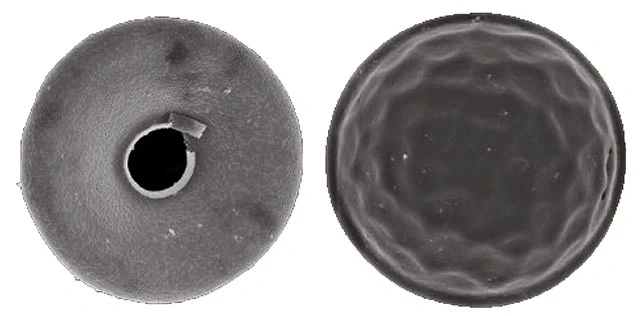
Arcella guadarramensis González-Miguéns & Lara, 2021
Diagnosis: Color ranges from transparent to yellow-orange. Sub hemispherical test shape, with flattened edges and dimples in the surface that gives the test a golf ball shape. No ribs or keels on the aboral side. Hexagonal building units are visible, which gives the test a rough appearance; little pores can be seen at the vertices. Building units can also be appreciated at the oral side of the test, with pores at the vertices and a central aperture. The aperture is invaginated outwards forming a short ring or lip.
Dimensions: According to González-Miguéns et al. (2021): Shell diameter: Clade L: 114—126 μm; aperture 19—30 μm; Clade M: 141—150 μm; aperture 31—35 μm.
Ecology: Wet Sphagnum moss, in a fen.
Geographical distribution: Type locality: Spain, Madrid, Puerto de Canencia (40°52’N 3°45’W).
Intraspecific variability. The building units may vary slightly in shape. Some building units may be collapsed, giving a rough surface. There may be certain deformations in the test that prevent it from having a perfectly circular morphology.
Diagnosis with closely related species. Arcella guadarramensis can be diagnosed by its specific sequences of the mtDNA markers and by its phylogenetic placement. Arcella guadarramensis differs morphologically from similar-looking G. succelli by (1) its morphometric differences with G. succelli, both, clade N and O, are notably smaller than G. succelli and (2) the rough outlook of the test.
References: González-Miguéns, R., Soler-Zamora, C., Villar-Depablo, M., Todorov, M., Lara, E., 2021. Multiple convergences in the evolutionary history of the testate amoeba family Arcellidae (Amoebozoa: Arcellinida: Sphaerothecina): when the ecology rules the morphology. Zoological Journal of the Linnean Society zlab074. https://doi.org/10.1093/zoolinnean/zlab074