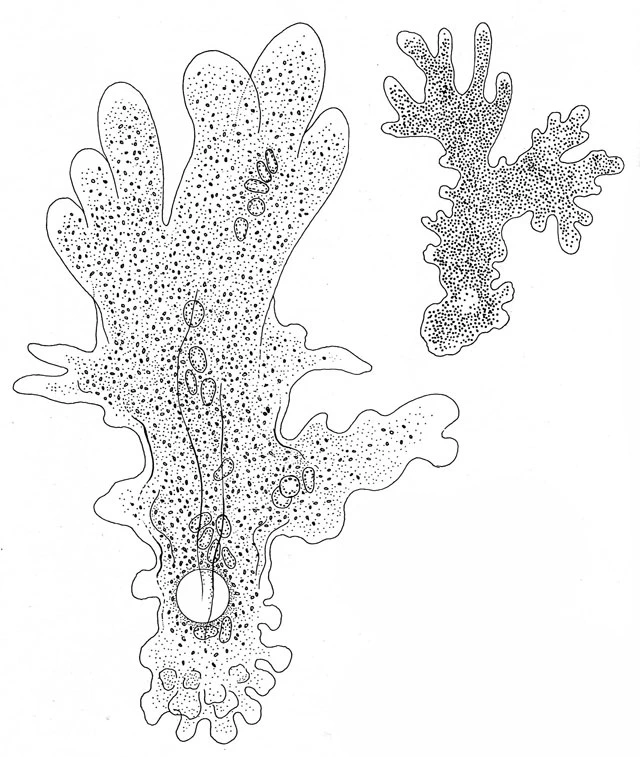
Genus Chaos Linneaus, 1767
Diagnosis: Locomotive amoebae usually polypodial, resembling a dead tree with thick, truncate branches; in rapid locomotion becoming monopodial. Large, commonly 600–1500 µm long, but reaching up to 5000 µm. Pseudopodia typically with longitudinal ridges. Uroid morulate. Multinucleate, with up to 1000 or more nuclei. Nuclei spherical, biconvex, or ellipsoidal discs, containing granular
Ecology: Freshwater habitats, including ponds and rivers, especially in floating debris in early spring. Not rare.
Remarks: The only light‑microscopical difference between Amoeba and Chaos is the number of nuclei. Under light microscopy, the cytoplasm of Amoeba proteus appears identical to that of Chaos carolinense (Andresen, 1956). I have collected populations of Chaos containing both multinucleate and uninucleate specimens.
I have sampled and observed numerous Chaos specimens in the Netherlands (several widespread locations), Sweden (Mörrum River), and England (Cambridge, pond). Even within a single population, nuclei were spherical, discoid, or convex, ranging from 9.6–48.0 µm in diameter.
Most measurements in the literature come from cultured material. Chaos carolinense has been maintained in culture for decades worldwide. The culture of Chaos illinoisense became extinct after 18 years, but the species was rediscovered in north‑west Russia. In reality, we know surprisingly little about these large amoebae. They are not particularly rare—but who is actually looking for them?
Although a key to the species may be a useful tool for beginners, for an experienced worker it is a source of doubt—a minefield. See the species descriptions below.
>
Key to the species:
| 1a | Polypodial forms 700–2000 µm; monopodial forms up to 5 mm or rarely more; nuclei biconvex discs, 22–31 µm (mean 27 µm); up to ~1000 nuclei per amoeba; crystals mostly bipyramidal; cysts reported | Chaos carolinense |
| 1b | Polypodial forms < 1000 µm; monopodial forms < 2000 µm | → 2
|
| 2a | Polypodial forms 500–800 µm; monopodial forms up to 1500 µm; nuclei spherical, 14–16 µm; several hundred nuclei per amoeba; numerous large bipyramidal and plate‑like crystals; cysts smooth, spherical, ovoid or elliptical, with endocyst and ectocyst widely separated; cyst diameter 250–350 µm | Chaos illinoisense |
| 2b | Polypodial forms < 800 µm; monopodial forms < 1500 µm
| → 3
|
| 3a | Polypodial forms 240–820 µm; monopodial forms up to 1200 µm; nuclei ovoid or biconvex discs, 13–23 µm; 6–60 (or more) nuclei per amoeba; crystals bipyramidal; no cysts observed | Chaos nobile |
| 3b | Polypodial forms ≥ 280 µm and ≤ 600 µm; nuclear number and morphology variable
| → 4
|
| 4a | Polypodial forms ~500 µm; monopodial forms 420–980 µm (mean 816 µm); amoebae usually monopodial in locomotion with distinct lateral wrinkles; few individuals polypodial; crystals truncate bipyramids, spindles, and cubes; nuclei discoid or biconvex, ~20 µm in diameter, 6–30 per amoeba; floating form radial | Chaos glabrum |
| 4b | Polypodial forms 280–600 µm; crystals bipyramidal or bipyramidal + plate‑like; nuclei spherical, discoid, concave or convex; nuclear number variable
| → 5
|
| 5a | Polypodial forms 360–600 µm; monopodial forms up to 1300 µm; nuclei spherical, discoid, concave or convex, 9.6–48.0 µm (mean 22 µm); 2–119 nuclei per amoeba (mean 27 µm); crystals bipyramidal and plate‑like, 2.2 µm, occasionally up to 7.9 µm; cysts observed | Dutch species |
| 5b | Polypodial forms 280–500 µm; nuclei spherical or convex, 11.2–41.7 µm; 1–48 nuclei per amoeba; crystals bipyramidal; no cysts observed | Swedish species |