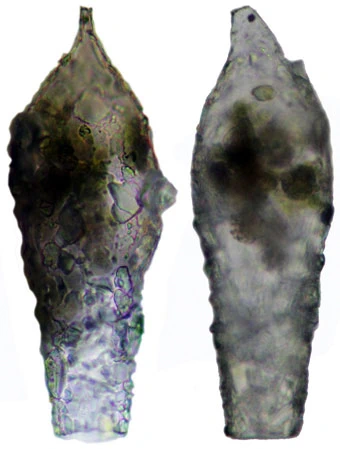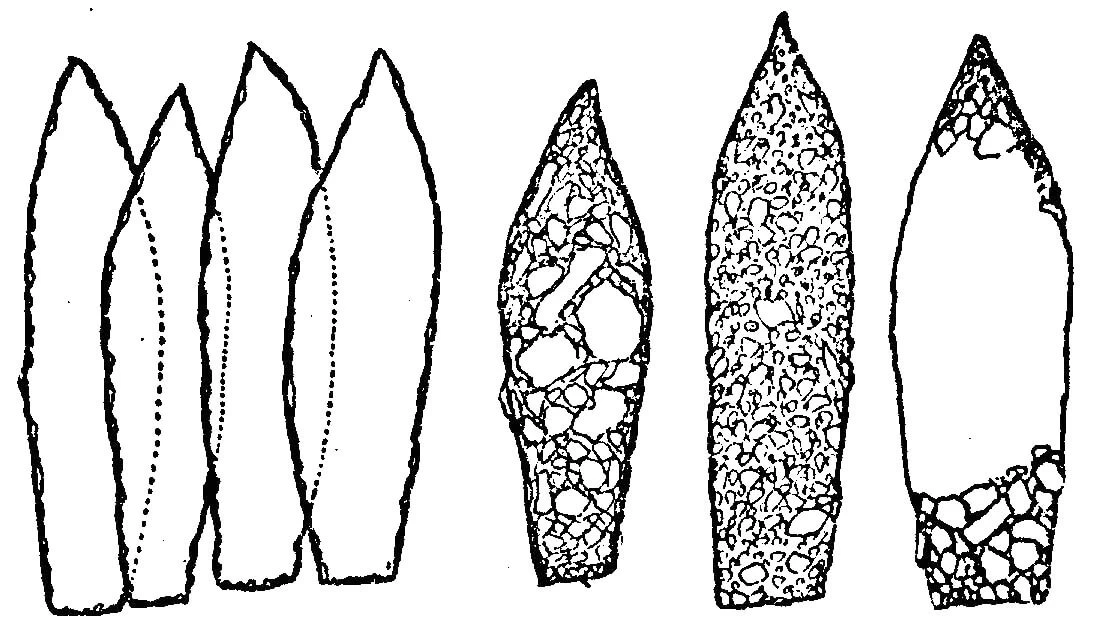
Difflugia smilion Thomas, 1953
Probably junior synonym of Difflugia scalpellum Penard
Diagnosis: Shell bilaterally symmetrical, cylindrical, gradually swelling from the aperture for about two-thirds of the body length to the widest diameter and then tapering in the last third of the body length to a blunt or sharp, asymmetrically shaped apex, the outline of which resembles in lateral view the dorsal fin of a shark. Shell usually hyaline, composed of quartz particles and diatom frustules, giving it the appearance of a regular smooth surface. Aperture usually circular.µm Nucleus ovular, with nucleoli arranged close to the nuclear membrane.
Dimensions: Thomas (1953): Shell length 210-220 µm, aperture diameter 30-50 µm (France, Belgium). Gauthier-Lièvre and Thomas (1958): 170-216 µm (Africa).
Ecology: Freshwater; in oligotrophic and mesotrophic ponds, also between sphagnum. Europe, Africa.
Remarks: Questionable species. According to Thomas (1953), this species is identical in shape and size to D. scalpellum Penard, 1899, but in the same paper he also states that D. smilion is significantly smaller (“nettement inférieures”) than D. scalpellum. As Penard (1902) gives an average length of 250 µm, in one place he found an average length of 220-230 µm, you may wonder whether those are really significantly smaller dimensions. The main difference between D. smilion and D. scalpellum, according to Thomas (1953), is their ecological niche. Penard (1902) only found D. scalpellum in lakes at a depth of 30-100 m, while D. smilion was found in very shallow water. Without further explanation, Thomas (1953) notes that there are differences between the two species when observed in polarized light.
Gauthier-Lièvre and Thomas, 1958, describe D. smilion var. major with a length of 275-300 µm (Africa).