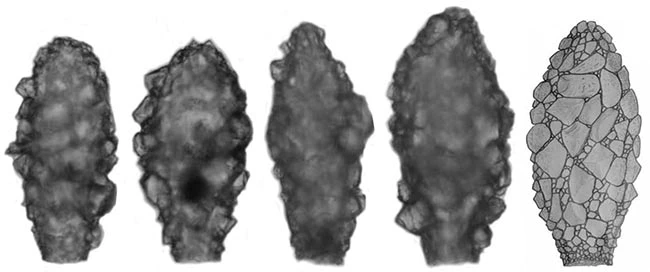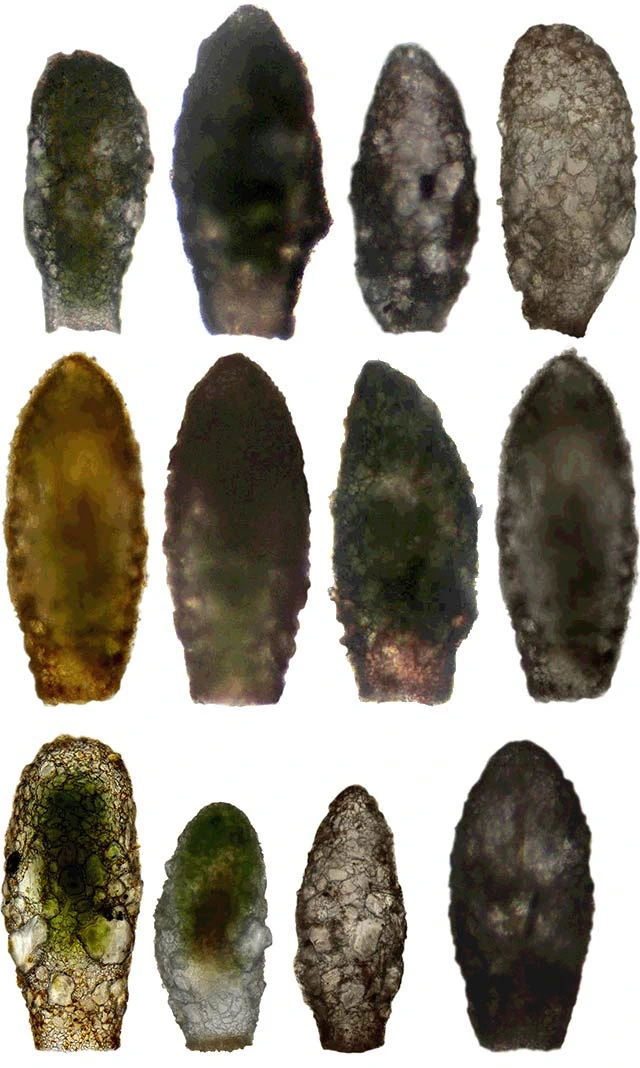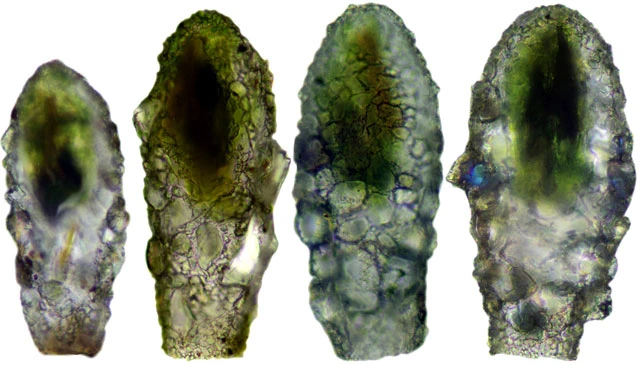
Difflugia yorkui Nicholls, 2007
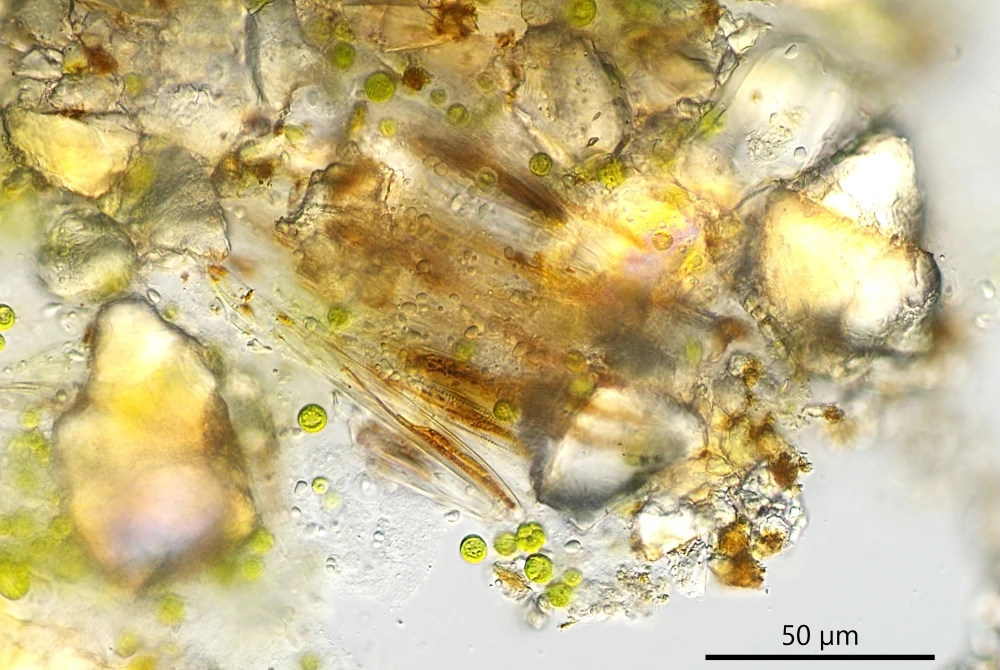
Diagnosis: Shell large, elongated oblong, usually with a distinct neck and covered with large and irregularly shaped siliceous particles except in the anterior region where particles are very small; test roughly circular (not compressed) in transverse cross-section, tapering towards both anterior and posterior ends from its widest point at about the middle of the test. Aperture relatively small and circular. Organic basal material of the test (cement) organized in an open-meshed pattern of pores 0.3-0.8 µm in diameter separated by ribs 0.2-0.4 µm in width. With zoochlorellae. Nucleus ovular, densely filled with numerous small spherical nucleoli.
Dimensions: Nicholls (2007): Length 305—370 µm; width 140—162 µm; aperture 50—63 µm in diameter (n=12); my measurements: Length 222—517 µm (mean 372 µm); width 116—219 µm; aperture 56—101 µm (n=73).
Ecology: Freshwater. Sediment. Belgium (Chardez (1980) as D. pyriformis longicollis); Canada (Nicholls (2007); Netherlands (Naardermeer and several other locations, this website); Croatia (Jopićeva cave, Siemensma, pers. observation, 2023).
Remarks: The identity of the Dutch shells was confirmed by Nicholls (pers. comm., 2021).
This species was also reported and pictured by Chardez, 1980, who called it D. pyriformis longicollis Gassowsky (see below).