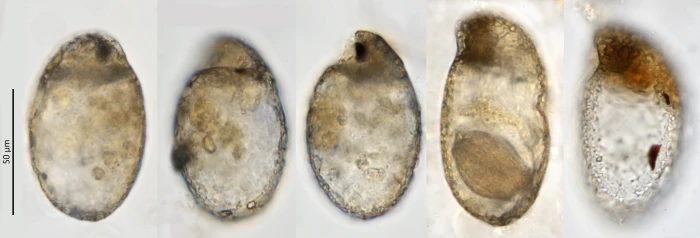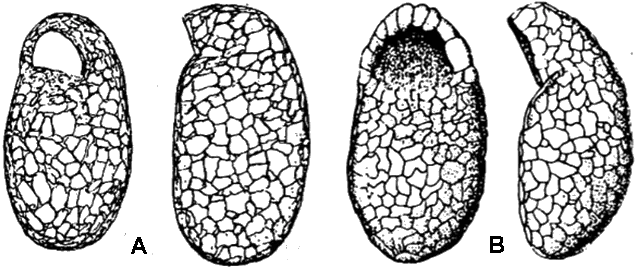
Hoogenraadia capucina (Bonnet, 1975) Wanner et al., 2025
Diagnosis: Plagiostome-type shell with a visor. Oval-shaped body with a well-defined flat base. The visor is fairly prominent and not distinctly separated from the body. In dorsal or ventral view, the outline is elliptical. The visor aperture is semi-circular. The plane of the aperture forms an angle of approximately 20° with the long axis of the shell body. The surface is covered with siliceous particles, generally reworked and very small, closely interlocked, larger at the aboral end.
Dimensions: According to Bonnet (1975): Shell length 70—78 µm; height 35—40 µm.
Ecology: Very common in ferruginous tropical soils of gallery forests or plateau forests.
Geographical distribution: Tropical Africa, in the Lamto Savanna region, Ivory Coast (Bonnet, 1975; Coûteaux, 1976), Japan (Siemensma, 2024); Brasil (2024; https://tecamebas.com.br/centropyxis-capucina/.