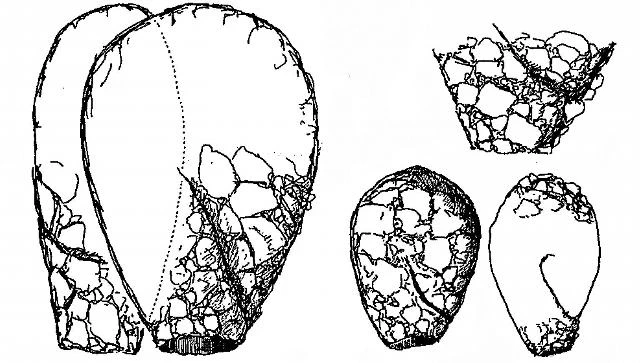
Lesquereusia mimetica Penard, 1911
Diagnosis: Shell very large compared with other Lesquereusia species. Shell strongly compressed, ovoid with straight cut pseudostome; test divided in two rooms by a long more or less straight and diagonal septum. This septum is strongly obscured when the test is covered with large dark xenosomes, thus resembling a large compressed Difflugia or Pontigulasia species.
Dimensions: Length 370-420 µm (mean 310 µm); Thomas & Gauthier-Lièvre (1959): L 400-460; width 280-350 µm; thick 170-200 µm; pseudostome 90-115 µm; xenosomes 50-90 µm.
Ecology: Freshwater. Rivers and marshes in tropical forests. Africa: Sierra Leone (Penard, 1911), Ivory-Coast, Congo (Thomas & Gauthier-Lièvre, 1959).
References: Thomas, R., Gauthier-Lièvre, L., 1959: Le genre Lesquereusia Schlumberger 1845 (Rhizopodes testacés). Bull. Soc. d’Hist. Nat. l’Afrique du Nord, 388, 50: 34-86.

Thomas and Gauthier-Lièvre (1959) described the variety parva as follows: “Its overall aspect resembles that of the typical form, though it is significantly smaller. The surface has a quartz-like texture, reminiscent of certain forms of L. modesta. However, the variety parva differs from that species in that its neck is not detached from the body. Instead of a coiled structure, a partition creates the neck, forming a sort of passageway toward the pseudostome.”