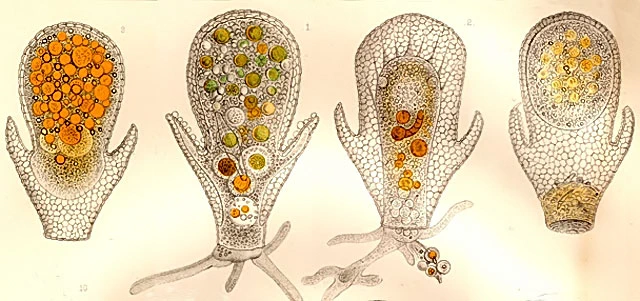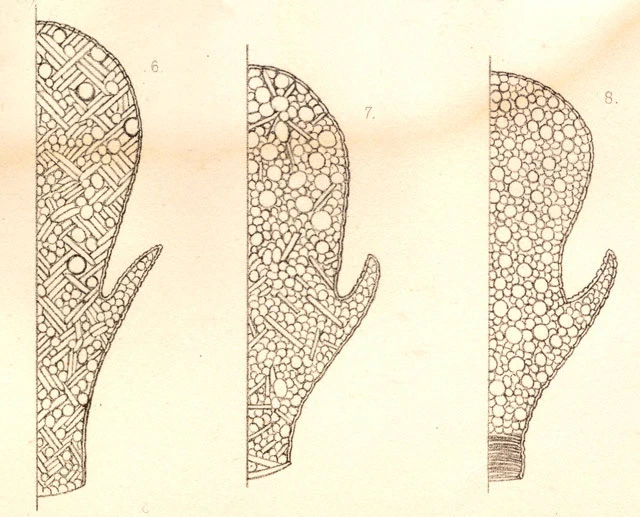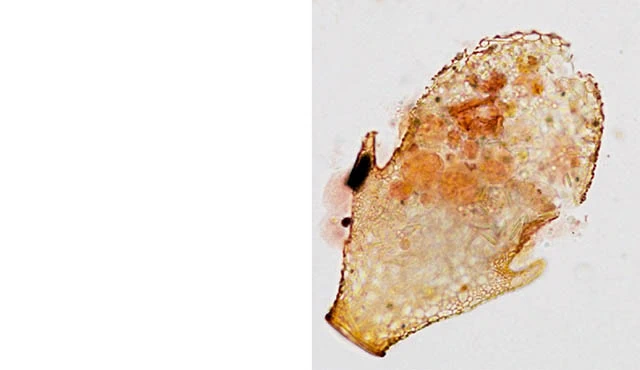
Cornutheca ansata (Leidy, 1874) Kosakyan et al., 2016
Diagnosis: Shell pyriform in broad lateral view, laterally compressed, with a pair of hollow horns protruding, one on either side of the neck one-third of the distance from the aperture to the fundus. Shell almost transparent or slightly yellowish-brownish, composed of small oval particles probably predated from small euglyphids. Aperture slightly curved in broad lateral view.
Dimensions: Shell length (195) 220—264 (270) µm; width (between the ends of the lateral horns) (110) 130—150 (169) µm; width of the main body 90—125 µm; horn length 25—59 µm; aperture 40—55 µm wide.
Ecology: in Sphagnum-dominated peat lands.
Geographical distribution: North-eastern part of North America.
Remarks: This easy recognizable, even for non-specialists, and remarkable species has a very limited distribution range in the temperate part of eastern North America. Joseph Leidy found this remarkable-looking shelled protozoan while making microscopical investigations of samples from Sphagnum, collected from cedar swamps near Absecom and Malaga, Gloucester County in New Jersey, USA. Since these initial investigations, only four publications have reported finding this species, at a site near the original Leidy locality (Stokes, 1882; Hoogenraad & de Groot, 1952) and at a site near Lanoraie, in southern Quebec (Fantham & Porter,1945). Recently it has been rediscovered in New Jersey and Nova Scotia (Heger et al, 2011).
References: Heger, T. J., Booth, R. K., Sullivan, M. E., Wilkinson, D. M., Warner, B. G., Asada, T., Mazei, Y., Meisterfeld, R. and Mitchell, E. A. D.: Rediscovery of Nebela ansata (Amoebozoa: Arcellinida) in eastern North America: biogeographical implications – Journal of Biogeography 38, issue 10, 1897-1906, 2011.