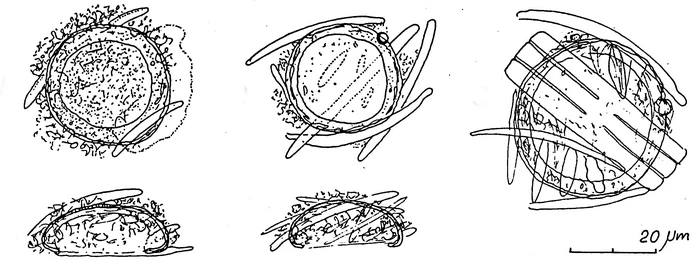
Pyxidicula crustatus Chardez, 1981*
* Proposed to transfer to the genus Phryganella.
Diagnosis: The test is shaped like a watch glass with a dome of variable height, composed of a fairly thick yellowish chitinoid varnish, always covered by a greenish organic felt and incrusted with diatoms, sometimes of large size. Punctuations similar to the thecal structure of arcellids are difficult to observe because of the relative thickness of the chitin and the diatom covering. They are visible only in young individuals that are still lightly incrusted with exogenous material and whose chitinoid varnish is more transparent. The pseudostome is very large and more or less circular; it is never invaginated.
The cytoplasm is extremely hyaline and only slightly mobile in this species, which appears to move very little; it is therefore difficult to speak of lobed pseudopodia. The pseudopodial emissions consist of thin cytoplasmic sheets extending only slightly beyond the edge of the test. The nucleus is spherical and measures about 5 µm.
Dimensions: Extreme measurements observed: test diameter 26–40 µm; pseudostome diameter 21–32 µm; test height 15–20 µm.
Ecology: Freshwater; this species lives in contact with Sphagnum leaves, within masses of green organic material.
Remarks: Chardez considered this species to belong to Pyxidicula, but the presence of a xenosome covering contradicts this placement. It is highly probable that this species belongs to Phryganella and may be conspecific with Phryganella acropodia.