Heleopera lucida
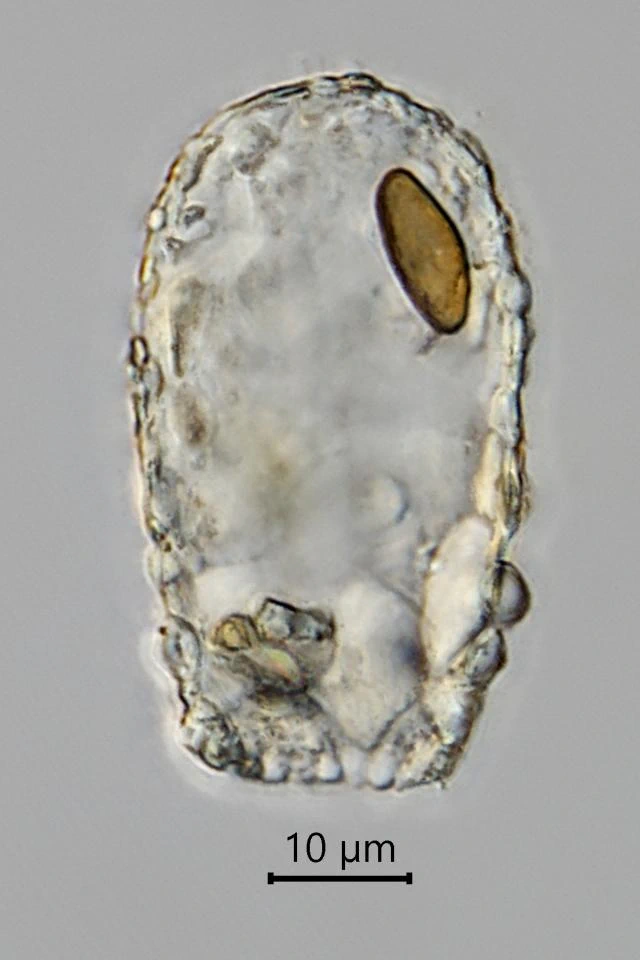
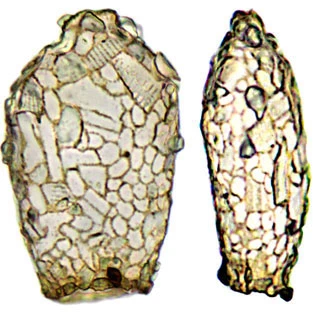
Heleopera lucida, in frontal and lateral view; moss, Netherlands

Heleopera lucida (Penard, 1890) Porfirio-Sousa et al., 2023
Basionym: Difflugia lucida Penard, 1890

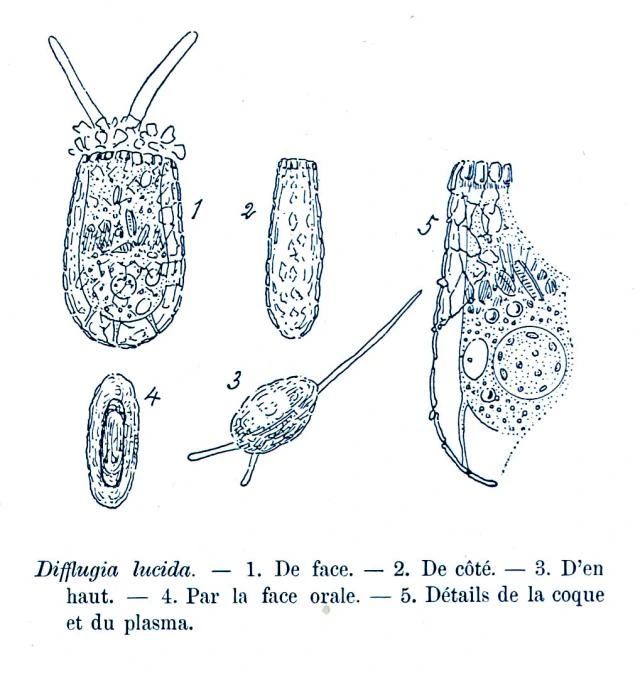
Diagnosis: Shell hyaline, more or less U-shaped and strongly compressed, covered with flat quartz particles. Living individuals accumulate mainly inorganic material round the elliptic aperture. This aggregation of particles is probably drawn into the shell when the amoebae encysts and is lost when the cell dies. Nucleus ovular, about 10 µm in diameter, with a number of irregularly shaped nucleoli. Pseudopodia relatively thin.

Dimensions: Penard (1902): 50-60 µm, up to 65 µm. Todorov and Bankov (2019): Length 65-83 µm, width 33-56 µm, apertural width 20-41 µm.

Habitat: Freshwater, soil and mosses. A common species, cosmopolitan.

Heleopera lucida
Heleopera lucida
Heleopera lucida, nuclei arrowed
Heleopera lucida
Heleopera lucida, 64 and 68 µm
Heleopera lucida
Heleopera lucida

Heleopera lucida, , dry moss, the Netherlands

Heleopera lucida
Heleopera lucida
Heleopera lucida, 68 µm, Crailoo, the Netherlands and, H. lucida, 70 µm, Tirol, Austria
Heleopera lucida
Heleopera lucida
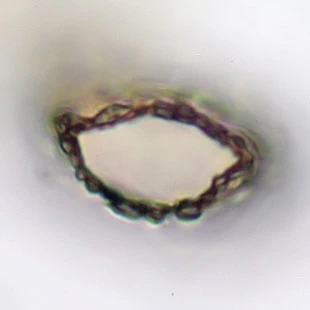
Heleopera lucida, right: lateral view, 70 µm – Tirol, Austria, and aperture of the specimen to the left.
Heleopera lucida
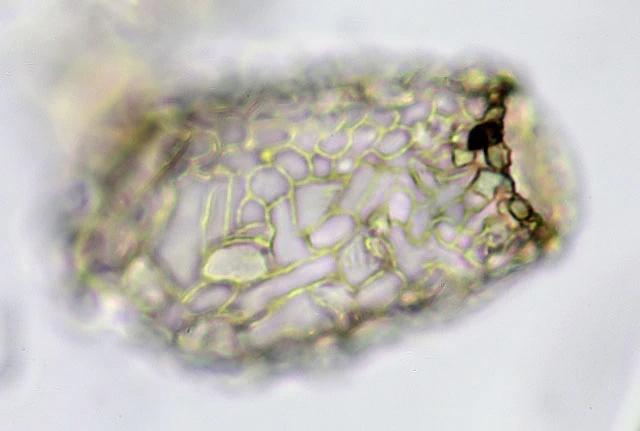
The same shell as above; note the darker grains around the pseudostome.
Heleopera lucida
Heleopera lucida
Heleopera lucida, both c. 60 µm, xerophyll moss, Germany
Heleopera lucida
Drawing: Penard (1902) in Faune Rhizopodique du Bassin du Leman
Heleopera lucida
Stacked image partly showing the covering with flat xenosomes
Heleopera lucida
Two living cells of Heleopera lucida – Photomicrography Angie Opitz, Austria.
Ferry Siemensma, created February 23, 2019; last modified October 16, 2024
Recent posts