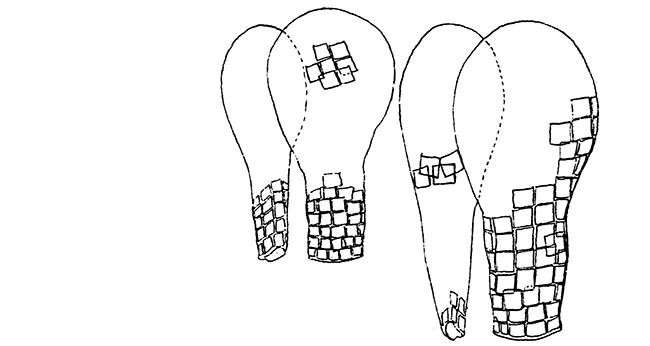
Quadrulella tubulata (Gauthier-Lièvre, 1953) Gauthier-Lièvre & Thomas, 1961
Diagnosis: Shell almost lageniform, compressed, with rounded fundus and more or less irregularly arranged, commonly small, square plates. Pseudostome straight or slightly curved, with or without a thickened edge.
Dimensions: According to Gauthier-Lièvre (1953): Shell length 70—100 µm; width 30—45 µm; pseudostome 20—22 µm.
Ecology: Freshwater and mosses.
Geographical distribution: Yvory Coast, Congo, Africa. South America: Argentina, Brazil; Africa: Congo, Guinea, Ivory Coast, Madagascar, South Africa; Europe: Bulgaria, Romania, Spain; Australasia: New Guinea (Papua New Guinea (According to Kosakyan et al., 2025).
Remarks: This might be a “mirror” species that could either be a result of convergent evolution or represent cases of the “classical” hyalosphenids (A. vas, Padaungiella ssp.) that live in environments where euglyphids are rare but Quadrulella are abundant enough to provide material for building their shells. Quadrulella tubulata is possibly identical or closely related with Padaungiella tubulata specimens that embedded preyed Quadrulella plates in their shells. Therefore, Q. tubulata must be treated as incertae sedis, and only sequencing will certainly illuminate the conundrum of the evolution of square-shaped plates (after Kosakyan et al., 2016).