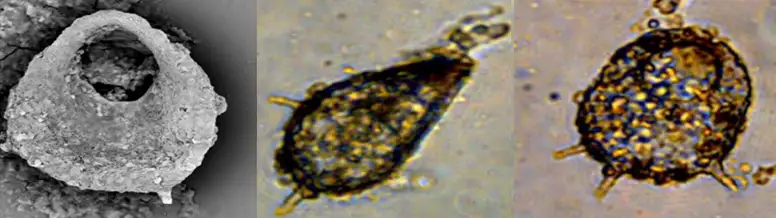
Centropyxis blatta Ribeiro & Lara, 2023
Diagnosis: Shell yellow, brown or colourless, becomes darker with ageing. Ovoid in apertural view. Aperture oval and sub-terminal. Rounded fundus (=opposed to the aperture) and flattened near the aperture in lateral view. Variable number of spines (0–4, n = 25). Shell composed of exogenous material (usually mineral particles) attached with an organic cement.
Dimensions: Shell length: 54.77–77.31 μm, average 66.34 μm (N = 25); shell width 28.20–45.70 μm, average 36.41 μm (N = 25); aperture 19.98–40.42 μm, average 27.59 μm (N = 25). Shell breadth: 48.43–74.03, average 59.99 (N = 25). Spine length: 7.66–20.39 μm, average 11.65 μm (N = 19).
Ecology: Freshwater sediment. Type locality: eutrophic pond in Parque del Universo, Parla, Madrid.
Geographical distribution: Madrid, Spain.
Remarks: The general morphology of Centropyxis blatta fits within the C. aculeata broad morphotype (Amesbury et al., 2018). However, it is considerably smaller than the type description by Ehrenberg (1838), who cites a length of 1/18 Linie (118 μm). The general shell outline of Centropyxis oblonga resembles C. blatta but is twice as large (Deflandre, 1929). At the current state of knowledge of Excentrostoma diversity, there is no closely resembling species described. Additionally, Centropyxis blatta can be diagnosed by its specific COI and SSU rRNA sequences and by its phylogenetic placement.