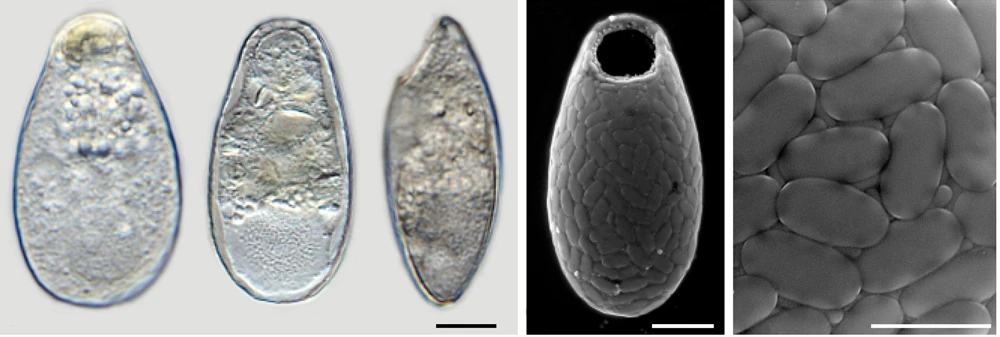
Armatura murmillo Łuców & Siemensma, 2025
Diagnosis: In ventral view, the shell is elongated-ovoid, gradually narrowing towards the aperture, elliptical in cross-section, colorless, and transparent. In lateral view, the shell has a biconvex outline. The shell is composed of two types of scales: (1) large oblong scales that more or less overlap each other and (2) smaller broadly elliptical to oblong scales that lie beneath the larger scales and cover the gaps and transitions between the large scales. Small scales are also arranged around the aperture. The aperture is relatively small, circular, invaginated, and bounded by one row of small denticulate apertural scales. One finely granulated, irregularly shaped nucleus is present, sometimes with a cluster of granules, posteriorly located and about 13 µm in diameter. Pseudopodia are thin, straight, and sometimes very long.
Dimensions: Łuców et al. (2025): Shell length 42.8–52.8 µm; width 20.1–32.4 µm; depth 15.8–23.4 µm; aperture 7.4–11.4 µm; large scales 4.3–5.2 µm.
Ecology: Freshwater, peatland.
Geographical distribution: Type locality: Khar Zurkhnii Khukh Nuur fen, Mongolia.
Remarks: Live specimens could not be distinguished from Trinema specimens under light microscopy. Only when dried specimens or empty shells were observed under light microscopy did the typical oblong scales become visible. Scanning electron microscopy (SEM) photographs showed that this species has small scales beneath the interstices of the large scales, on the inner side of the shell. These small scales were also visible in phase contrast microscopy.
References: Łuców, D., Siemensma, F., Avirmed, D., Obremska, M., Słowiński, M., Zawiska, I., 2025. Morphological and morphometric investigations on testate amoebae from Mongolia with descriptions of a new genus and four new species. European Journal of Protistology 97, 126128. https://doi.org/10.1016/j.ejop.2024.126128
