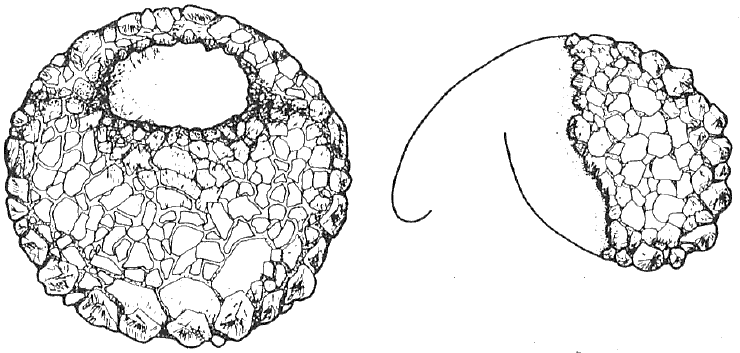
Centropyxis sp. with teeth
Diagnosis: Shell hemispherical in lateral view and nearly circular in dorsal view, with the frontal side sometimes more flattened. Shell usually composed of numerous small quartz particles, sometimes mixed with or replaced by small diatoms, embedded in a layer of organic cement. Aperture almost circular, strongly invaginated to about one third of the shell height. Frontal lip smooth; ventral lip ornamented with small, sharp, tooth‑shaped xenosomes.
Dimensions: Length 118–131 µm; width 123–167 µm; height 93–111 µm; aperture diameter 33–49 µm.
Ecology: In Sphagnum, Store Mosse National Park, Sweden, 2026.
Remarks: This Centropyxis resembles C. orbicularis, but differs from Deflandre’s (1929) description by its almost circular and smaller aperture, as well as its larger size. Deflandre described the aperture of C. orbicularis as “elongated‑elliptical, more arched along the margin that follows the outer contour (of the shell).” The Swedish specimens may represent an undescribed species. In both general shape and aperture structure, they closely resemble the form described by Lüftenegger et al. (1988) as C. orbicularis (see bottom of this page).