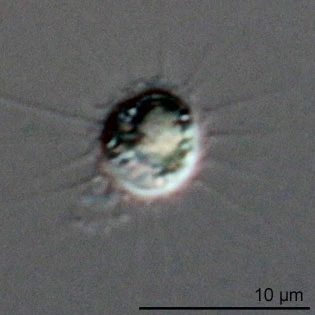
Belonocystis quadrangularis Nicholls, 2012
Diagnosis: Cells spherical, with a prominent eccentric nucleus; 1-3 contractile vacuoles; cells, lacking chloroplasts, phagotrophic, motility by fine pseudopodia, covered with a single type of organic spine consisting of a long, tapered, hollow shaft with a pyramid-shaped base comprised of four arms or struts, originating from an irregularly shaped nodal swelling at the base of the main spine shaft; base of the main spine shaft distal to the basal struts, 0.23-0.30 µm in diameter and tapering yo a distal tip that is about 0.07 µm in diameter.
Dimensions: Cells 5-9 µm in diameter; nucleus 3-4 µm in diameter; contractile vacuoles up to 3 µm in diameter; spines 15-20 µm long, arms or struts 1.6-1.8 µm long.
Ecology: Fresh water. North-America, Europe.
Remarks: The four-legged basal structure of the spines can be observed with differential interference contrast, see the photomicrographs above which were made with an Olympus UPLANFL 100X.
References: Rainer, 1968, Nicholls, 2012. Diagrammatic representation of a living cell: CV contractile vacuole; N nucleus; n nucleolus; f filopodia; fv food vacuole; ss spine scale – from Nicholls, 2012