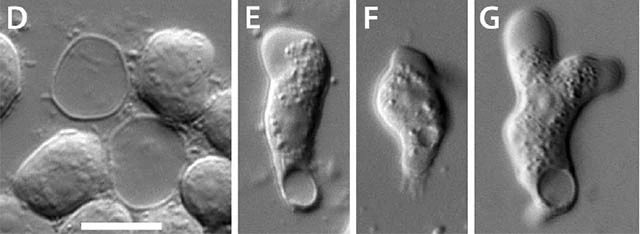
Copromyxa protea (Fayod, 1883) Zopf, 1885
Synonyms. Guttulina protea Fayod, 1883
Copromyxa arborescens Nesom & Olive, 1972
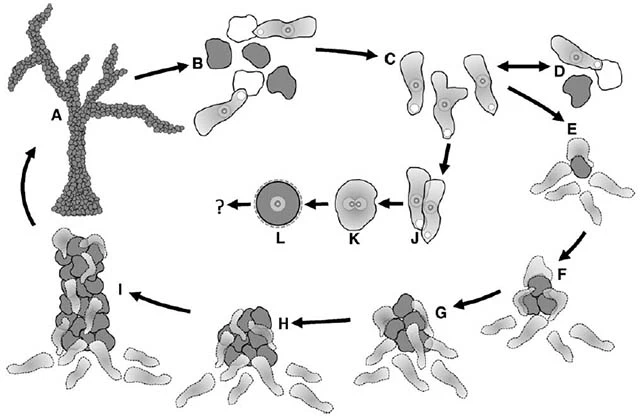
Diagnosis: Amoebae in active locomotion typically monopodial in form with a well-pronounced hyaline cap and a round to tapering uroid. Uroid not differentiated, but often adhesive filaments form. Locomotive amoebae limax in form, but not eruptive; length/breadth ratio mean approximately 4. Normally a single vesicular nucleus with a single nucleolus. Cysts smooth walled, spherical, ovoid, or irregular in shape. Known to fruit via aggregation and differentiation of amoebae into columns or arborescent masses of irregularly shaped, walled sorocysts. A possible sexual cycle involving thick walled sphaerocysts reported for some strains of the fruiting species.
Ecology: Dung-inhabiting amoeboid, originally isolated from bovine dung that was collected from a private cattle farm in Reeds Springs, Missouri, U.S.A.
Remarks: Copromyxa protea is a dung-inhabiting amoeboid organism that aggregates to form simple macroscopic fruiting structures, sorocarps, which are composed of a single cell type. In an effort to find the phylogenetic positions of the less well-known sorocarpic protists considered to be “cellular slime molds,” or aggregatively fruiting amoebae, Brown et al. (2011) isolated C. protea and sequenced the nuclear-encoded small subunit ribosomal RNA gene from four samples collected from cattle farms in the central USA. Phylogenetic analyses of these data place C. protea in the eukaryotic supergroup Amoebozoa together with the Tubulinea, in which there has been no previous report of an aggregative fruiting habit. This is consistent with the morphology of the trophozoites. In fact, Copromyxa protea is found to be very closely related to Hartmannella cantabrigiensis and to a since lost amoeba isolate, Hartmannella sp. 4/3Da/10. This new grouping of Copromyxa + H. cantabrigiensis is sister to Glaeseria, which together are sister to the Amoebidae (Amoeba + Chaos). Brown et al. (2011) suggest renaming, H. cantabrigiensis as C. cantabrigiensis and designate isolate 4/3Da/10 as C. protea. Future work is needed to see if these newly assigned members of the genus Copromyxa also show evidence of an ability to fruit.
References: Brown, WM, Silberman, JD, Spiegel, FW: “Slime Molds” among the Tubulinea (Amoebozoa): Molecular Systematics and Taxonomy of Copromyxa. Protist, Vol. 162, 277–287, 2011