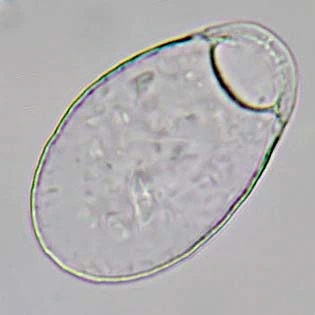
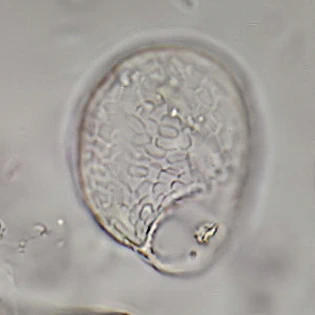
Corythium dubium, 35 and 32 µm
Corythion dubium Taranek, 1871
Diagnosis: Shell ovoid, composed of approximately four hundred oval shell-plates, irregularly arranged, very small and usually overlapping each other; aperture sub-terminal, oval and invaginated; about thirty small, oval, apertural-plates surround the aperture, each carrying a median dorsal tooth.
Dimensions: Shell length 33—43 µm; width 25 µm; aperture 10 µm; shell-plates length 2.9—3.4; width 1.5—1.9; diameter of apertural-plates 0.9—1.1 µm.
Ecology: Sphagnum and mosses.
Geographical distribution: Cosmopolitan.
Remarks: The apertural-plates are similar to those seen in Trinema enchelys and T. lineare. Differences in the size of the shell are illustrated by Cash et al., (1915).
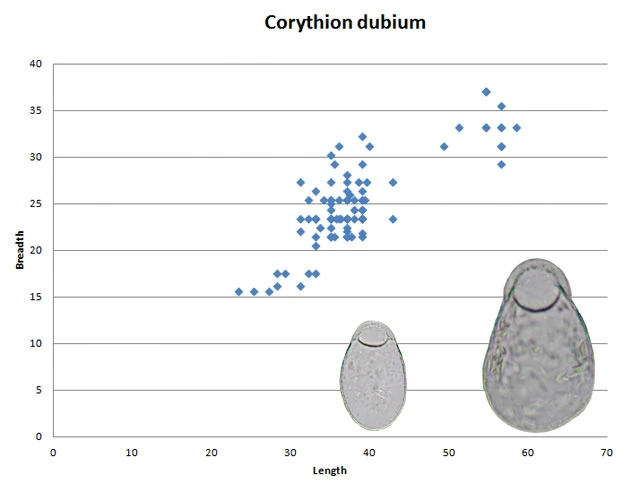
Morphometry of Corythion shells in a sample from a Sphagnum bog in Amersfoort, the Netherlands. Three groups can be distinguished. The left shell (C. dubium) represents the middle group and is 35 µm long, the other shell is 56 µm and represents the population to the right (C. constricta).
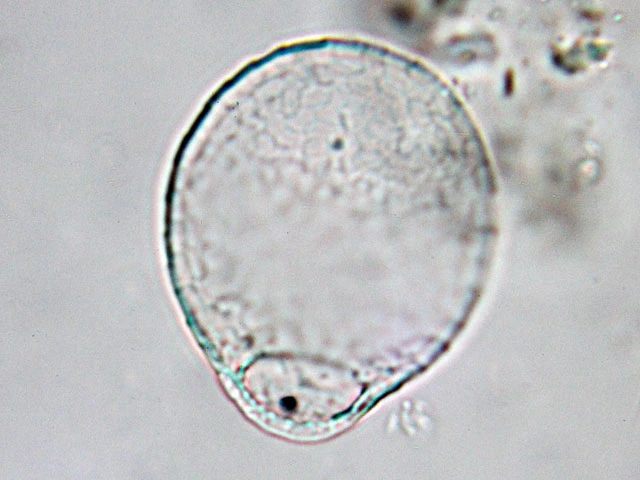
C. dubium, 39 µm

C. dubium, with small scales visible
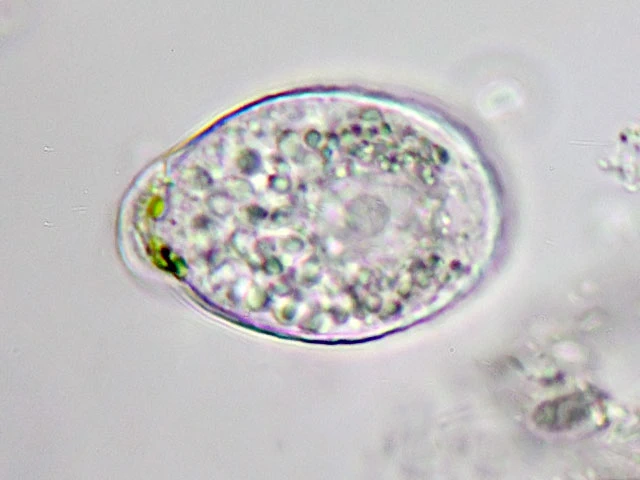
C. dubium, 35 µm, nucleus visible
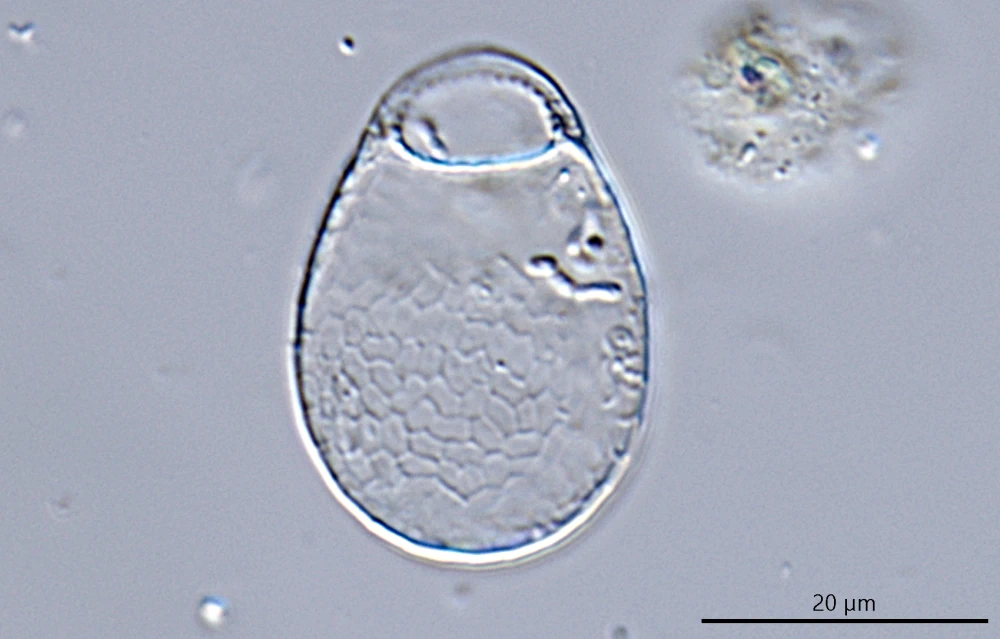
C. dubium, Reestdal, Netherlands, 2024
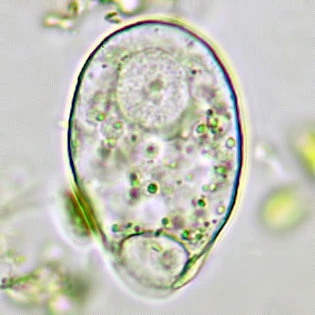
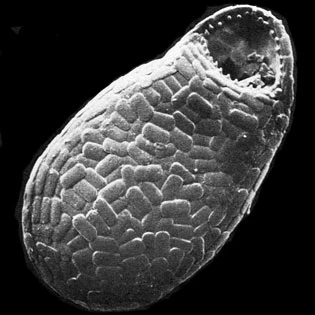
Left: Shell 37 µm, in moss on a roof; Right: from Ogden, 1980
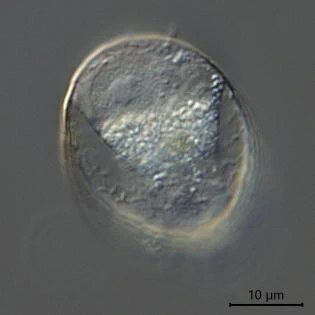
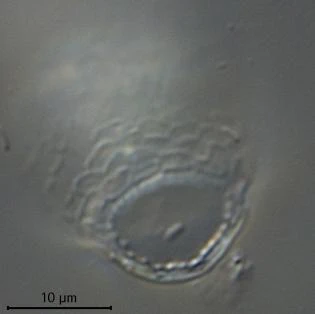
C. dubium, nucleus (L), pseudostome (R)