Polychaos annulatum (Penard, 1902) Smirnov & Goodkov, 1997
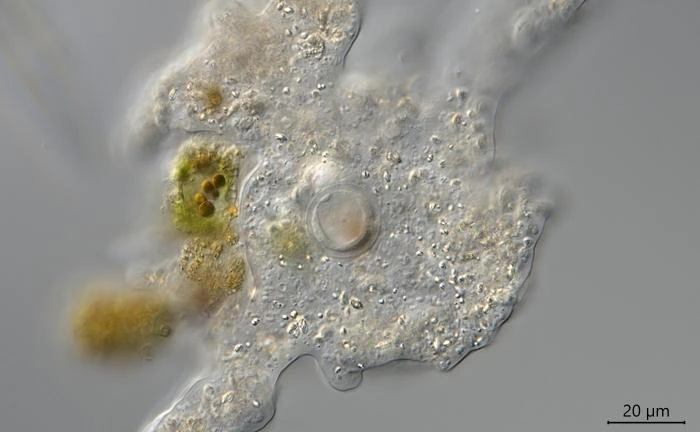
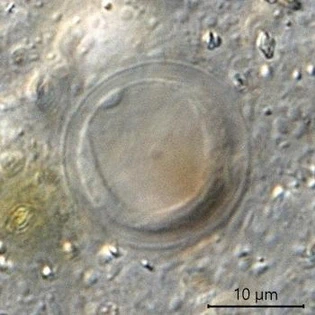
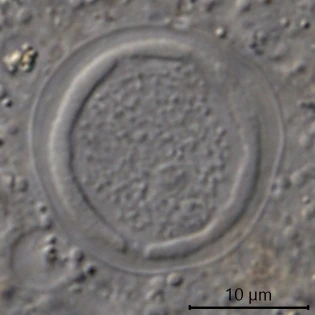
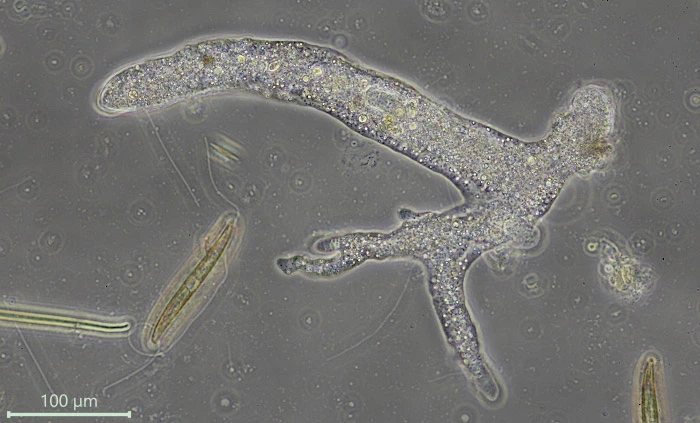
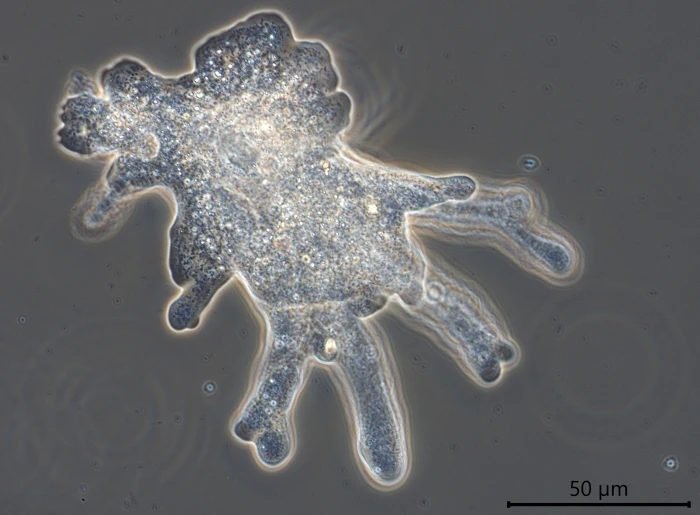
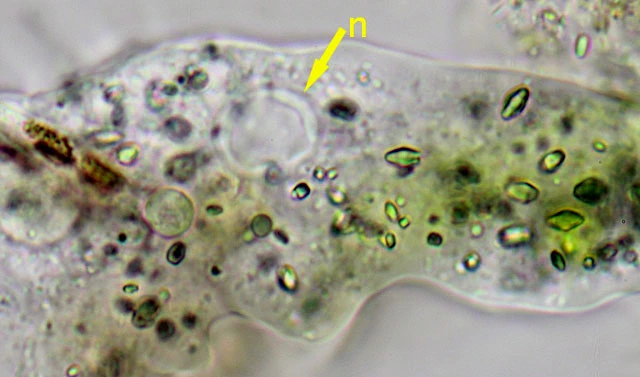
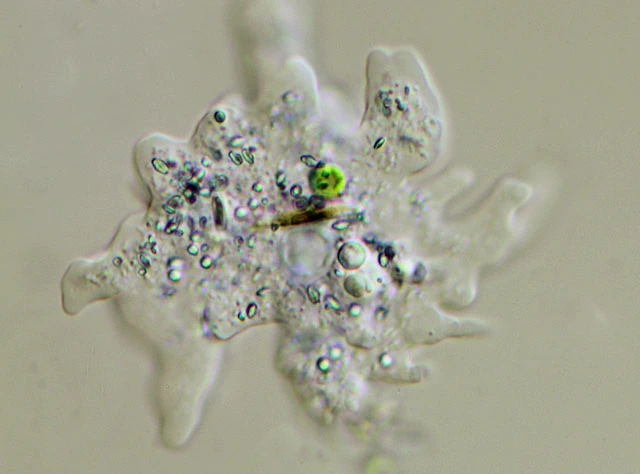
Diagnosis: Medium-sized amoeba with irregular polypodial shape during slow locomotion; palmate form with some short parallel pseudopodia; uroid bulbous in monopodial locomotive form and fasciculate in palmate form, sometimes with villi, usually very large fasciculate uroid, up to 1/2 of the body; crystals vary in shape and size, from small and irregular to bipyramidal and relatively large; monopodial form during rapid locomotion, may loose any distinct uroidal structures or have a bulbous uroid; nucleus spherical, with the nucleolar material forming a perforated sphere inside the nucleus, situated at some distance of the nuclear envelope. One contractile vacuole. No cysts reported. Floating form of the radial type, with a spherical central mass of the cytoplasm and short thick radiating pseudopodia. Often the amoebae float without taking the typical floating form.
Surface coat consists of very fine filaments, about 330 nm in length, often collapsing under inappropriate fixation.
Dimensions: Literature: 220-325 µm long, nucleus 12-25 µm; my measurements: monopodium 74-250 µm, nucleus 11-25 µm; crystals up to 5 µm.
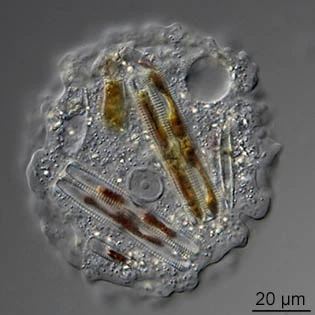
Ecology: Fresh water, on water plants and in sediment of ditches and shallow peat bogs. Common. Often with ingested pennate diatoms.
Remarks: I have collected it from several locations in the Netherlands (Naardermeer, Bert Bospad, Kromme Rade, Laegieskamp, IJsselmeer). This species can be confused with Polychaos dubium, but can easily be distinguished by its characteristic nucleus and its smaller size.
This species varies in size. Smaller specimens have less pronounced pseudopodia and look more like a Mayorella species. In one of my cultures some specimens had a nucleus with a central nucleolus. I found it together with Trichamoeba sinuosa.
This species can also be confused with Polychaos fasciculatum, but the latter has a very distinct nuclear structure and often very irregular crystals. Careful examination of the 3D organization of the nucleolus always rules out any doubt about the species identification. Comparison of Polychaos fasciculatum-like amoebae was done by Smirnov & Goodkov (1998).