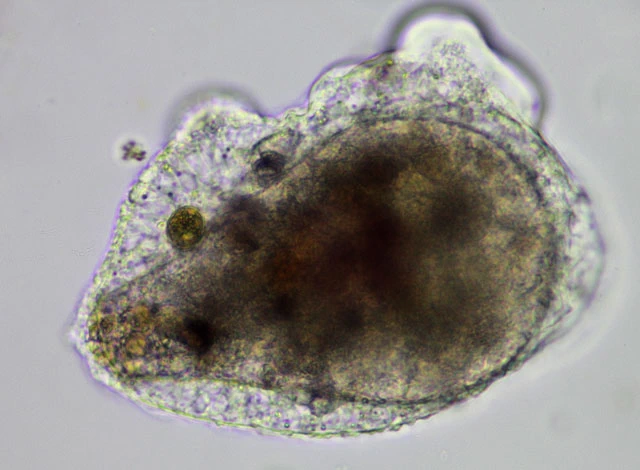
Pseudothecamoeba vesiculata (Penard, 1902) new comb., incertae sedis
Basionym: Amoeba vesiculata Penard, 1902
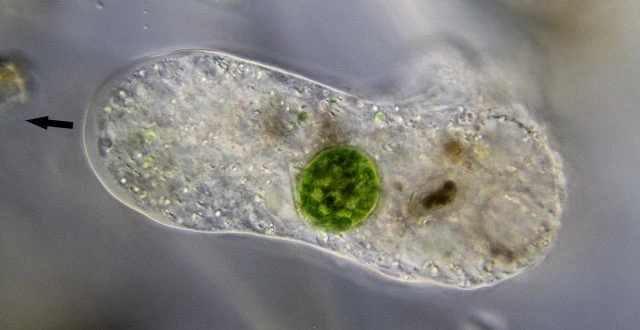
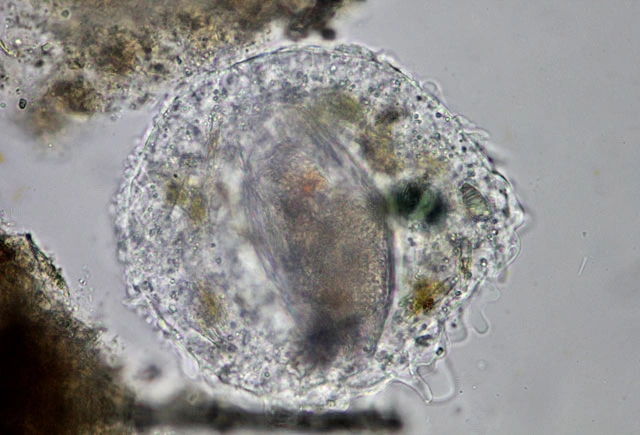
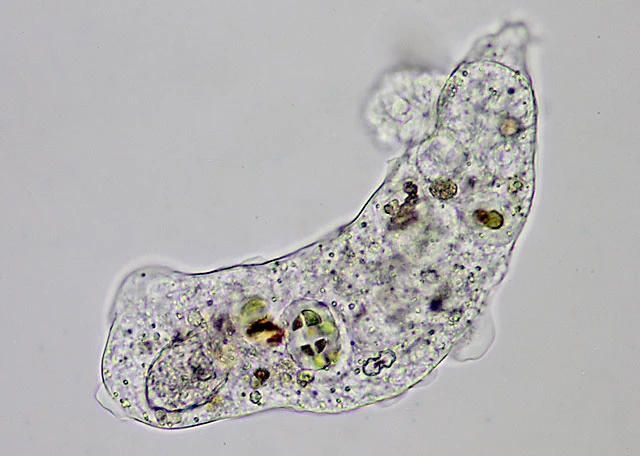
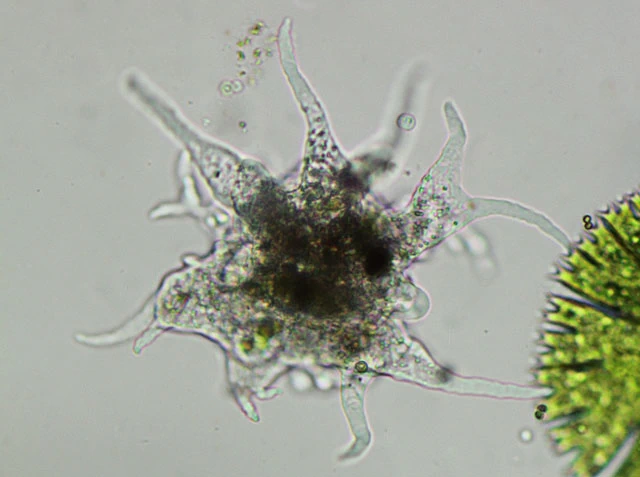
Diagnosis: Large amoebae, up to 400 µm; in rapid locomotion flattened limax-shaped, with a distinct hyaline cap, often extending along both sides. Cell filled with a large number of vacuoles which are very fluid and more or less elongated and often spindle shaped. Penard compares this shapes with those of cells visible in an orange when it has been cut through. Posterior part of the cell with longitudinal surface folds and wrinkles often extending far forward from the papillate uroid. One to three spherical contractile vacuoles. Nucleus relatively large, ovoid or disc shaped, with a large number of granular nucleoli, usually in the periphery, where they are irregularly distributed. Stationary specimens irregularly rounded or oblong.
Dimensions: Penard: up to 200 µm, mean 170 µm. My measurements: 170-400 µm, nucleus 15-49 µm.
Ecology: Sphagnum, peat bogs, mesotrophic ditches, between aquatic plants. Food: Algae, rotifers, testate amoebae. Not rare. Locally abundant.
I have found this species in large numbers in the Sima peat bog in Waidring, Tirol, Austria, and also in peat bogs along the Bert Bospad, in mesotrophic ditches in the Laegieskamp and in Crailoo, all in the Netherlands.
Penard has observed three specimens.
Remarks: Cells can be completely filled with food like rotifers and algae, resembling at first sight a Pelomyxa. The amoeba can capture large food particles, like Nebela species. This species can be confused with large Mayorella-species, like M. augusta. However, the typical shape of the nucleus is a clear characteristic.