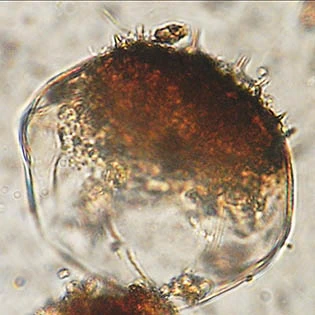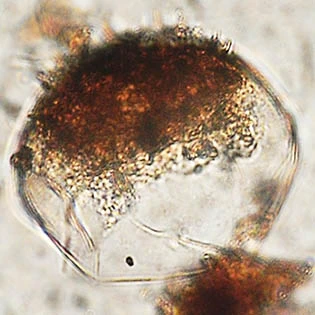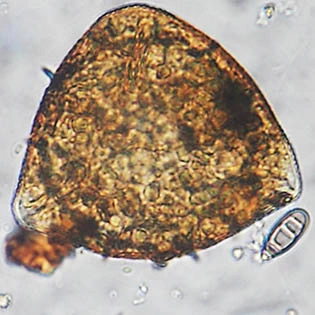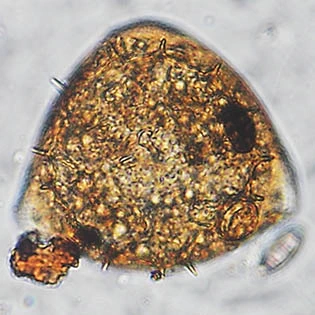
Microcorycia aculeata (Greeff, 1888) Cockerell, 1911
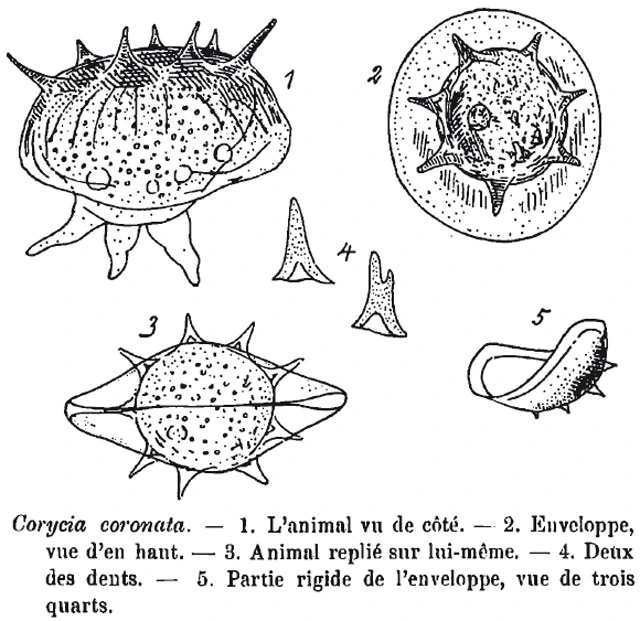
Diagnosis: Upper test part rigid, dome-shaped with a crown-like corona of 6 to 15 strong, big thorns and a wide base. The thorns are brown, hard, smooth and mostly apiculate, but in some cases bi-acuminate, according to Bartos (1940) differently big and high as well as often multiply acuminate and hollow at the base.
Dimensions: Greeff (1888): no dim.; Penard (1902): 140 µm; Bartos (1954): 100-160 µm; Gomes e Souza 105 x 90 µm (pers. comm. 2019).
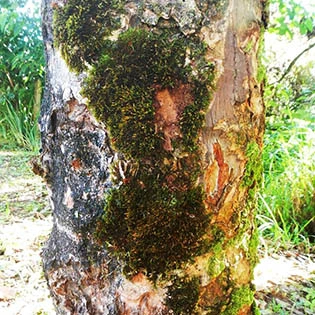
Ecology: M. aculeata populates predominantly moss, also sphagnum. Other biotopes or habitats have been stated less frequently. Penard (1902) indicates swamp. Varga (1962) found it in forest litter (L layer), Todorov (1998) in soil, and Balik (1986) in rendzina soil. It has also been found in limnetic biotopes. Lansac-Toha & al (2001) state generally inland bodies of water besides moss and sphagnum. It also occurs in plankton (Godeanu & Ionescu 1973, Godeanu 1977) and on reed (Godeanu 1977). Maria Beatriz Gomes e Souza found it in mosses on a tree in Itabirito, Minas Gerais, Brasil in 2019 (pers. comm.).
Remarks: Greeff (1888) gave no substantial information on the cell body. Penard (1902) referred to the fact that this species does not differ in the constituency of cytoplasm, pseudopodia as well in its entire physiology from M. flava. However, the nucleus has a centrally located nucleolus.
(all from Badewitz, 2004)