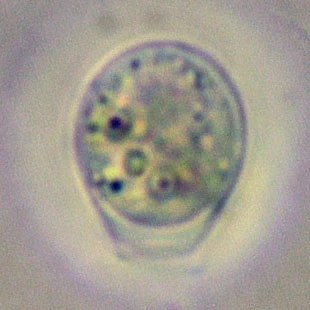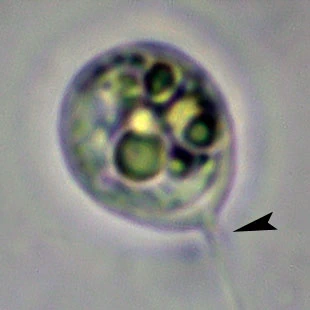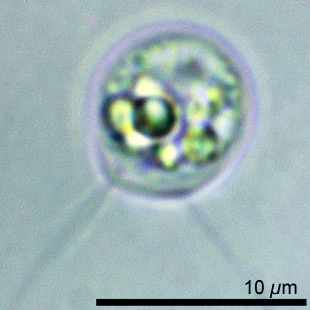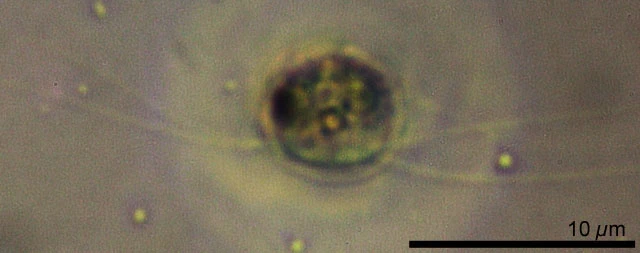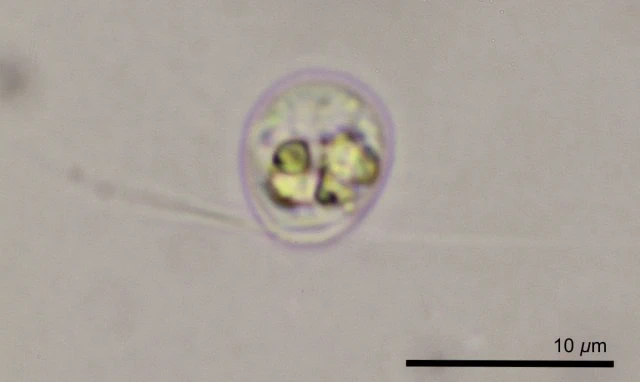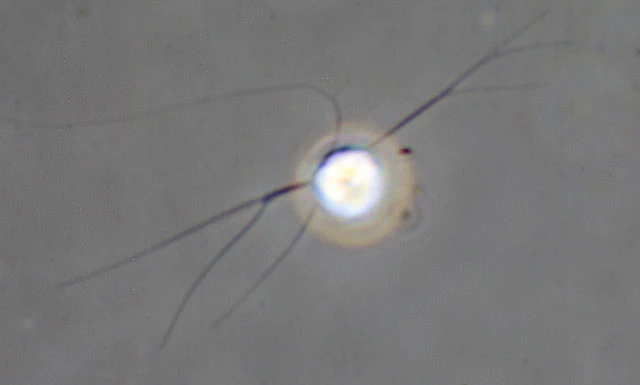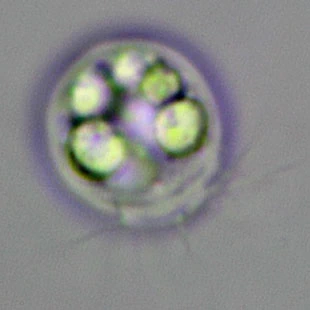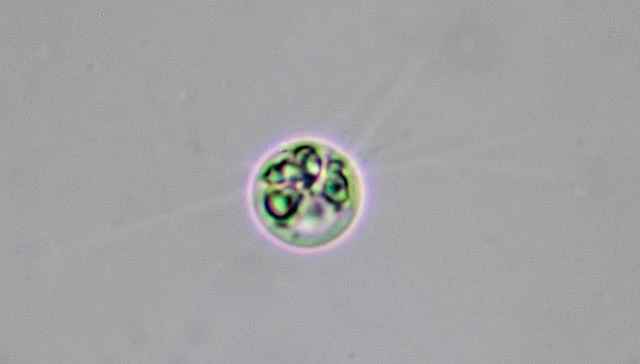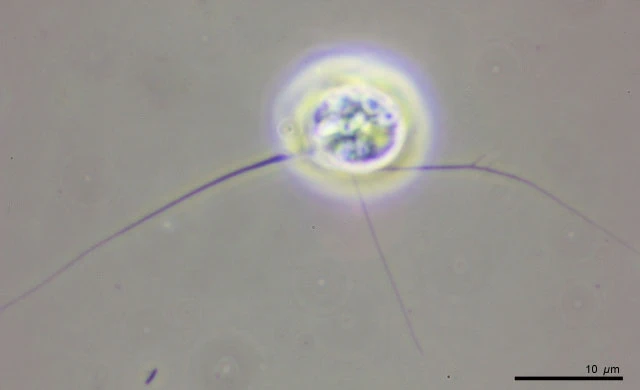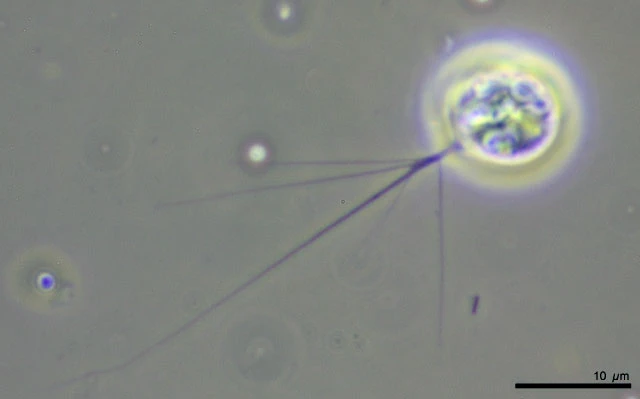
Rhogostoma spec.
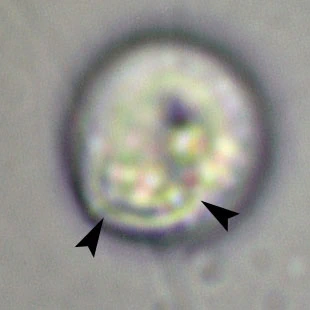
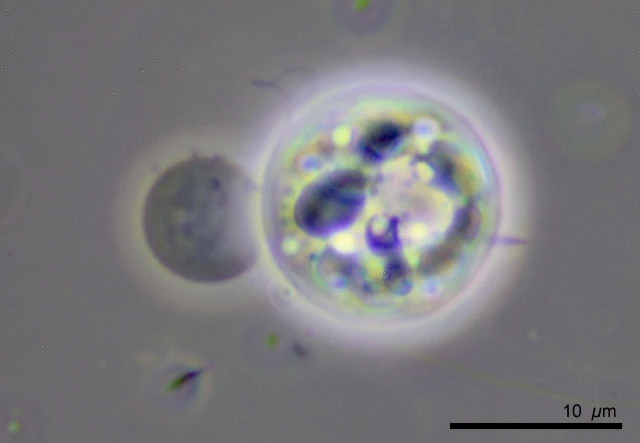
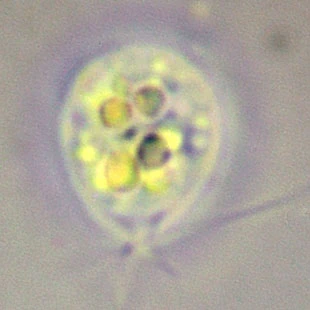
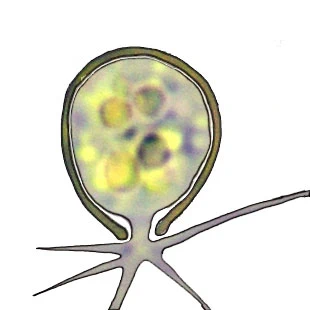
Diagnosis: cell spherical or slightly ovoid, with a semi-rigid colorless, hyaline membrane or pellicle; aperture a small cleft, hardly visible with a light microscope; plasma fills the test nearly completely; filopodia usually few, long and straight, branching, without granules; usually the filopodia taper, but sometimes a thin finger-like pseudopodium is formed. Usually two filopodia stretch in opposite directions, one being the leading one. Cytoplasm with one or more strong refracting bodies. Nucleus not observed. One to two small contractile vacuoles. Cell can be very mobile.
Dimensions: small species, Ø 8.5-12 µm.
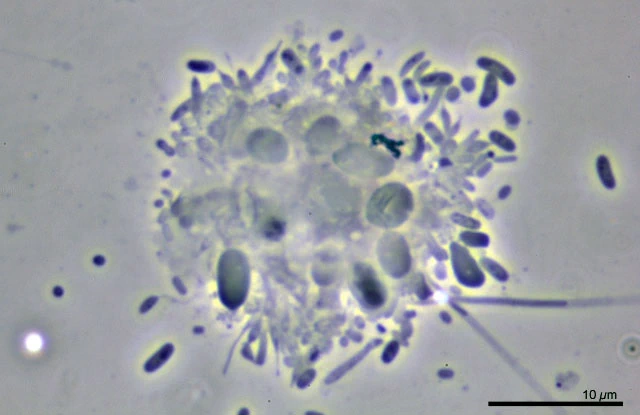
Ecology: Freshwater; feeding on bacteria. This species was found in a cold water tap in a kitchen in Zeist, The Netherlands. A sample was sent to me by Sandra Redeker, researcher at Het Waterlaboratorium in Haarlem, The Netherlands.
Remarks: I have placed this species in the genus Rhogostoma because of its slit-like aperture. Because of its minute size morphological details are hard to detect light microscopically. I couldn’t see any nucleus, maybe it has a granular structure.