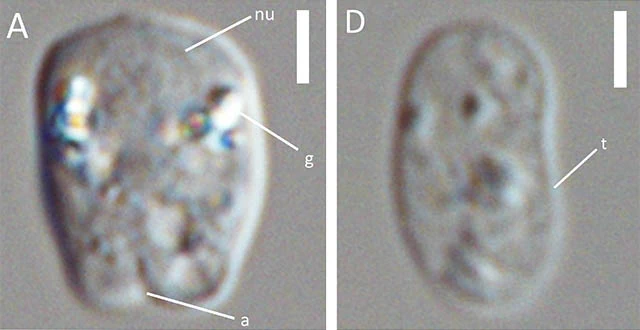
Rhogostoma cilindrica Flues and Dumack, 2017
Diagnosis: Shell cylindrical. Nucleus spherical, about 2–3 µm, with one spherical central nucleolus. Aperture cleft-like. Cells show a clear zonation (apical to basal): 1 zone of nucleus embedded in few granules, 2 food vacuoles, 3 aperture and contractile vacuoles, 4 filopodia or lamellipodia. Locomotion actively creeping, filopodia rarely extending to 30 µm. Prey mainly bacteria, potentially also very small eukaryotes. Cell division longitudinal, binary.
Dimensions: Shell length 9.9–11.3 µm, width 4.8–7.5 µm.
Ecology: Soil.
References:
Dumack, K., Flues. S., Hermanns, K. and Bonkowski, M., 2017. Rhogostomidae (Cercozoa) from soils, roots and plant leaves (Arabidopsisthaliana): Description of Rhogostoma epiphylla sp. nov. and R. cylindrica sp. nov.; Eur. J. Protistol. 60: 76–86.