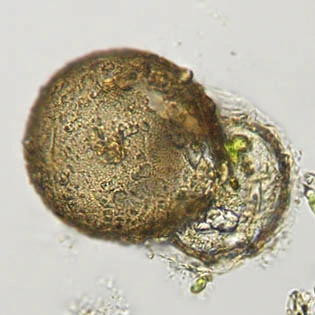
Conicocassis spec.
Diagnosis: The shell is divided in a perfectly spherical main body with a small circular aperture and a large, funnel-like visor which edge is completely circular without the U-shaped attachment as observed in C. pontigulasiformis. The main body has a darker color than the visor; both parts are composed of a granular organic matrix, embedded with some mineral particles and diatom frustules. The wall of the visor is relatively thin, with an outwardly curved edge, in contrast to C. pontigulasiformis which as an inwardly curved edge.
Dimensions: My measurements: Spherical chamber 60-66 µm in diameter (n=18)
Ecology: Peat bogs in het Hol and Laegieskamp, the Netherlands, Rotes Wasser, Germany and Tirol, Austria.
Remarks: As I had the possibility to study both C. pontigulasiformis and this species, I’m fully convinced that both are separated species. This characteristic species resembles in structure Centropyxis species, but differs from that genus in the smooth spherical body and the large pronounced funnel-like conical visor.
I have found this species in the Netherlands in the seventies (see my drawings below) and in 2012, in samples from Tirol, Austria, where it also has been found by Angie Opitz (pers. comm.). She found living individuals. I found many specimens in a sample from the peatland area Rotes Wasser in Germany, sampled by Steffen Clauss.
The shells on this page have been photographed from material which has been collected in peat bogs in Tirol, Austria. The drawings are from material from the Netherlands.

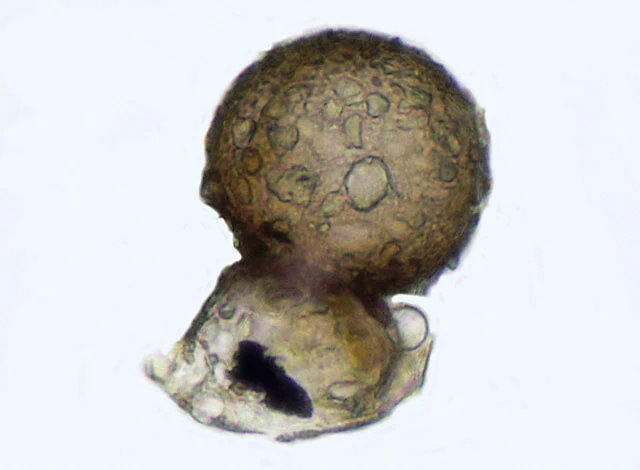


The photomicrographs below have been made by Angie Opitz, Tirol, Austria.