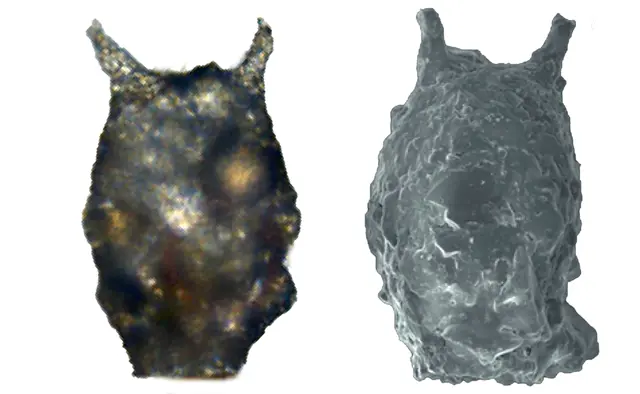
Cylindrifflugia luciferina Mauricio-Sánchez, Soler-Zamora and Lara, 2025
Diagnosis: . Opaque and robust test with shades of brown, grey and yellow, oval in shape, and with a neck and circular aperture. It has two aboral horns with a smoother and more transparent appearance than the rest of the test. The test is formed by minerals and environmental materials. The pseudopodia can reach a greater length than the test itself.
Dimensions: According to Mauricio-Sánchez et al. (2025): Shell length 206–242 μm; width 122–140 μm; aperture diameter 66–79 μm. Horns measurements: 32–38 μm length; 13–14 μm breadth (n = 3).
Ecology: Sandy sediment in a pond with abundant aquatic vegetation.
Geographical distribution: Type locality: Artificial pond in the Royal Botanical Garden in Madrid, Spain.
Differential diagnosis: Test morphology and the presence of two aboral horns resemble Difflugia bicornis Penard, 1890, but its test size (50–60 μm) rules out any confusion between both species. Difflugia diafana (Vucetich, 1978), a South American species, has a similar test length, but a much narrower test, and hence a smaller test width (108–114 μm). Erugomicula bidens (Penard, 1902) has a more regular shape, the texture of the test is less rough and the horns are relatively shorter. The dimensions of the test could fit with those described in the species Cylindrifflugia acuminata, but that species has a more elongated test, a single aboral horn, and does not have a constriction at the base of the aperture. Compared to the rest of the species of the genus Cylindrifflugia, it shares neither size nor test morphology similarities
Intraspecific variability: Some individuals can have their horns more separated from each other than others. There can be variations in the depth of the constriction at the base of the aperture.