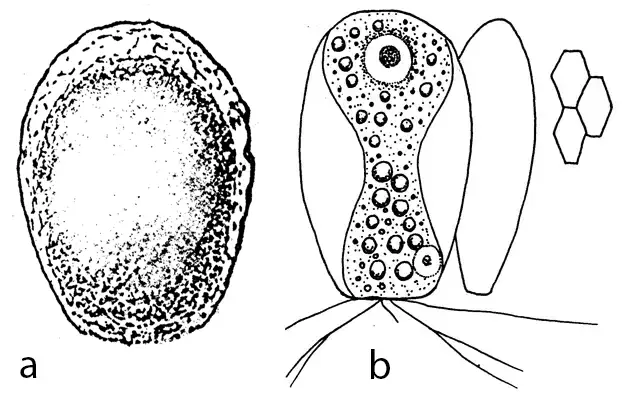
Placocista hyalina (Harnisch, 1937) *)
Basionym: Heleopera hyalina Harnisch, 1937
Synonym: Placocista spinosa var. hyalina (Harnisch, 1937) Schönborn, 1966
Diagnosis: Test broadly sac‑shaped, only slightly narrowed towards the pseudostome. Shell hyaline and highly transparent. Idiosomes composed of hexagonal, Euglypha-like plates that overlap slightly along the sides. In lateral view the test is compressed and tapers dorsally and ventrally. Pseudostome straight‑cut, slit‑like; plates extend up to the pseudostome margin. Cytoplasm contains zoochlorellae; pseudopodia filose. Nucleus with a central nucleolus.
This species differs from P. spinosa by the absence of spines and its more regularly oval outline. Shell dimensions fall within the known range of P. spinosa.
Dimensions: Schönborn (1966): Length 120.3–122.0 µm; Width 70.3–88.3 µm; Thickness 25.4–28.2 µm (n=4).
Harnisch (1937) reports a shell length of 120 µm. Specimens found by Grospietsch (1954) were partly somewhat smaller, although he also gives a maximum length of 118 µm. The lengths of P. spinosa range from 100 to 155 µm.
Ecology: This form occurs in moist Sphagnum and moist leafy mosses, and also in submerged Sphagnum. It was not found in dry mosses. Grospietsch (1954) characterizes the form as hygrophilous but not strictly confined to Sphagnum, a view that is confirmed by subsequent observations by Schönborn (1966). Schönborn did not encounter P. spinosa in his material, although Grospietsch (1954) reports it from similar habitats.
Distribution: Swedish Lapland.
*) Nomenclatural note: Heleopera hyalina Harnisch, 1937 was originally described as a species. Schönborn (1966) subsequently treated this taxon as Placocista spinosa var. hyalina, but this change of rank does not affect the availability, authorship, or date of the name under the ICZN (Art. 49). The provision that pre-1961 varieties are deemed subspecific names applies only to taxa originally established as varieties. Since hyalina was introduced as a species-group name in 1937, it retains its original status and authorship regardless of later treatment as a variety. Therefore, if recognized as a distinct species, the correct name is Placocista hyalina (Harnisch, 1937).