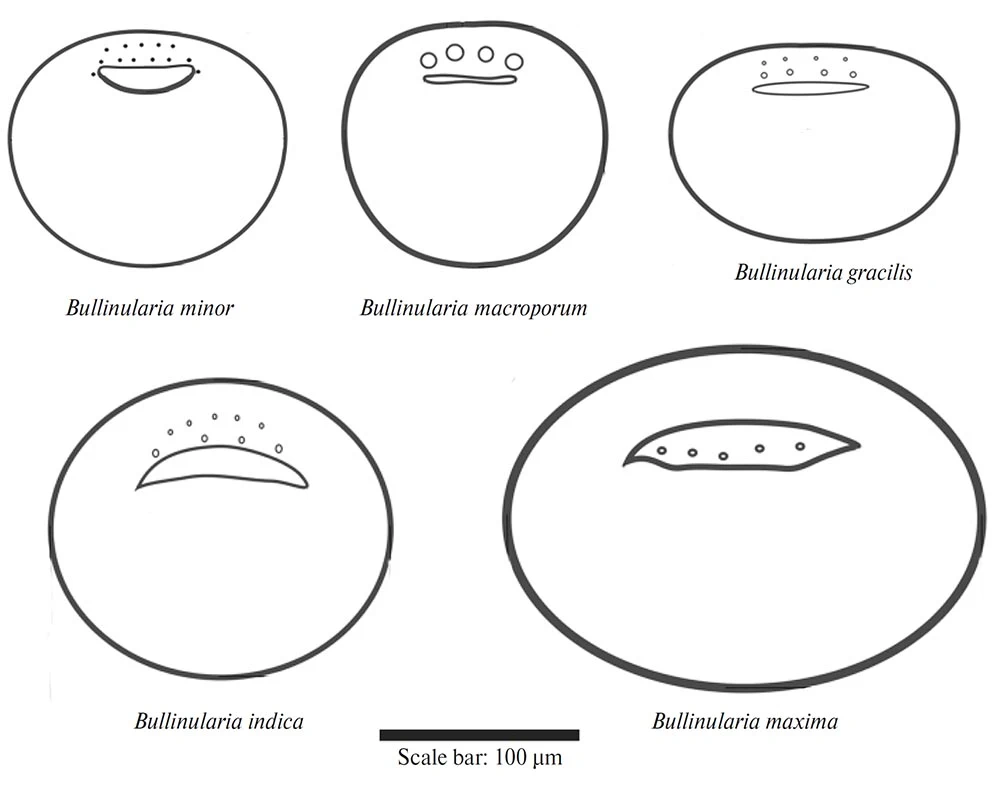
Bullinularia species, after Bobrov et al., 2020
Genus Bullinularia Deflandre, 1953
Diagnosis: Shell elliptical or circular in apertural view; hemispherical in lateral view, with a flattened, smooth ventral side. Test yellow to dark brown, opaque, partly covered with mineral particles embedded in organic cement. Aperture a long, eccentric, invaginated, curving slit, completely or partially hidden by the dorsal lip (cryptostome). The dorsal lip, and sometimes the ventral side, bears small or larger pores (a key character). Nucleus vesicular.
Type species: Bullinularia indica (Penard, 1907)
Ecology: Soil, mosses.
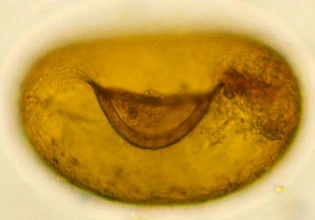
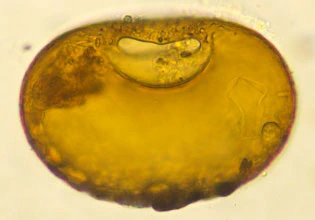
B. gracilis
Key to the species of Bullinularia
| 1 | Shell length exceeds shell breadth (mean l/b ratio is 1.13), ventral face is bellied, apertural furrow is very conspicuous | B. foissneri |
| – | Shell breadth exceeds shell length (l/b ratio less than 1.0), ventral face is flat, depressed | 2 |
| 2 | Shell breadth is more than 190 μm | B. maxima |
| – | Shell breadth is between 130 and 190 μm | B. indica |
| – | Shell breadth is less than 130 μm | 3 |
| 3 | Shell length/shell breadth ratio is 0.70–0.80; mean shell breadth is 120 μm; shell is chamois to brownish, transparent | B. gracilis |
| – | Shell length/shell breadth ratio is 0.85–0.95 | 4 |
| 4 | Pores on the dorsal lip are small (2–3 μm) and numerous | B. minor |
| – | Pores on the dorsal lip are large (7–8 μm) and few | B. macroporum |
From Bobrov et al., 2020