Chaos spec.
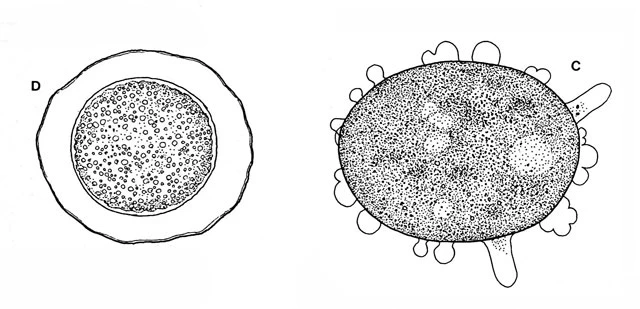
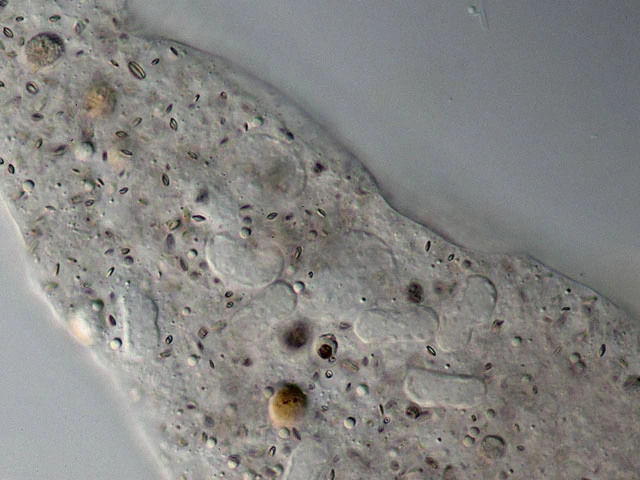
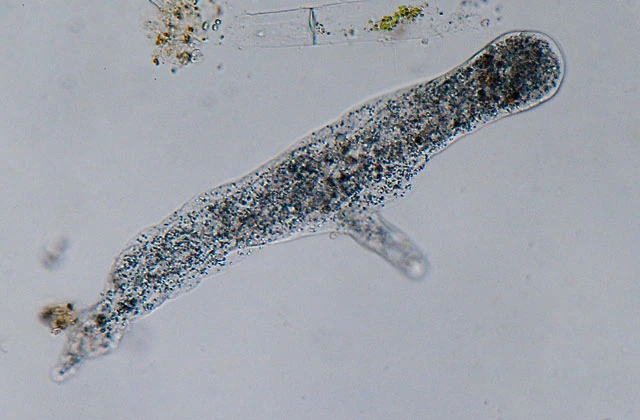
Diagnosis: Locomotive amoebae usually polypodial; in rapid locomotion becoming monopodial. Pseudopodia typically with ridges and wings. Floating form irregularly rounded with several long lobopodia. Uroid morulate. Multinucleate, with up to 120 nuclei. Nuclei spherical, ovoid, biconcave or biconvex discs, containing granular nucleolar material. Cytoplasm usually with bipyramidal crystals, sometimes mixed with plate‑shaped crystals. Cysts observed.
Dimensions: Monopodial forms 700–1600 µm; nuclei 9.6–48 µm (mean 22 µm); crystals approx. 2.2 µm, occasionally up to 7.9 µm.
Ecology: Often abundant in floating debris from ditches and ponds. In early spring, debris from the bottom may rise to the surface due to gas bubbles produced by blue‑green algae.
Remarks: I have found many specimens in the Netherlands (around Kortenhoef and in Dwingeloo), and some in England (Cambridge, pond) and Sweden (Mörrum River). A very rich population occurred in a ditch between Kortenhoef and Loosdrecht in May 1985. I obtained some specimens in cultures on maize grains, which survived for many years; cysts appeared in older cultures.
I am not certain that all observed specimens belong to a single species.
The number, size, and shape of the nuclei vary considerably. There may be a correlation between nuclear number and size: specimens with few nuclei tend to have larger ones than specimens with many nuclei. For example, in a specimen with three nuclei, each nucleus measured 36 µm, whereas in a specimen with 119 nuclei, the nuclei were 9.6 µm. Larger nuclei tend to be discoid, while smaller nuclei are usually spherical.
I have examined many specimens of this Chaos form, but the number of nuclei never exceeded 120.