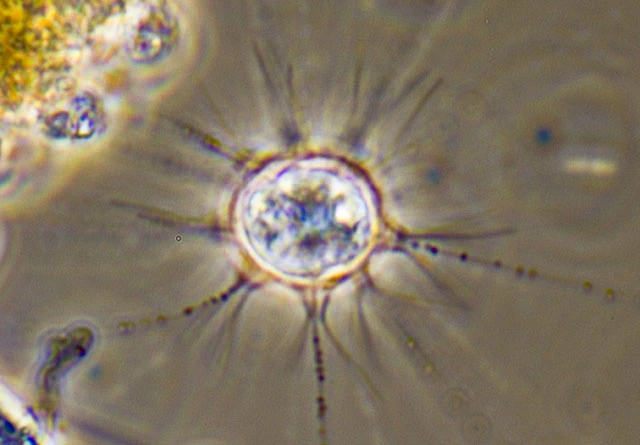
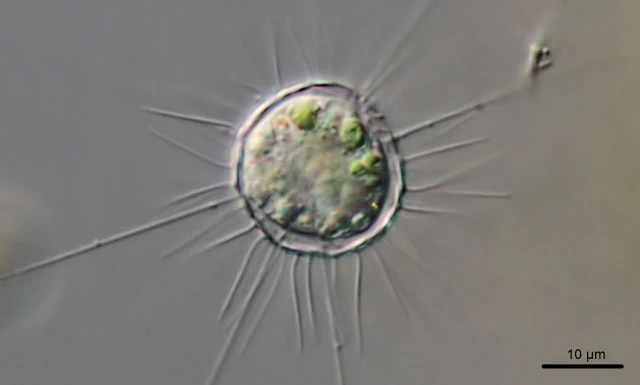
Choanocystis lepidula (Penard, 1904) Siemensma & Roijackers, 1988
Diagnosis: Cell diameter 10-18 µm, periplast up to 23 µm; spine scales 7.1-9.5 µm long; shaft cylindrical, 0.22 µm thick and with an abruptly cut off apex; shaft curved proximally and seated at the apex of an invagination of the basal plate; basal plate 1.7-1.8 µm in diameter and surrounded by an upwardly bent rim, ca. 0.1 µm thick; basal plate extends for a short distance along the shaft; plate scales 4.2-5.2 x 2.3 µm, ovoid to oblong, with a central depression, ornamented with irregularly distributed granules and with a narrow longitudinal rib.
Remarks: I have seen many proximally curved spine scales, but also many more or less straight shafts were observed. Therefore, it is likely that not all specimens have the typical habitat as shown by Penard’s (1904) single figure. Two related species are Choanocystis perpusilla and C. rotundata. The first differs from C. lepidula in having two teeth on its apex. The plate-scales of C. rotundata are smooth, whereas those of C. lepidula have a longitudinal rib.