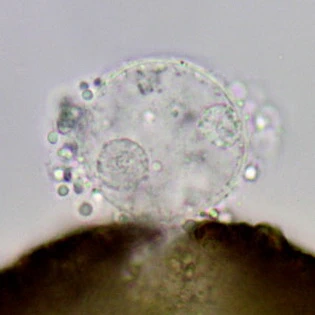
Cucurbitella vlasinensis Ogden & Zivkovic, 1983
Diagnosis: The shell is spherical to ovoid in shape, featuring a distinct apertural collar. The collar is trilobed and composed of small, randomly arranged quartz particles. A double layer of particles reinforces the three tooth-like projections, which form a dividing barrier with the inner apertural opening. These “teeth” are typically well-defined and constructed of small particles. Each lobe contains a small recess or cavity, resulting in an internal opening that is smaller than the external collar. The floor of these recesses appears as a continuation of the shell matrix. The apertural opening is also trilobed, aligning with the collar, and is lined with flat quartz pieces, with smaller particles filling the junctions.
The nucleus is vesicular, containing a spherical, hollow nucleolus. The shell is composed of a mixture of small to medium quartz particles, giving it a rough surface, though the overall outline remains relatively regular. The particles are densely packed, with only small areas of organic cement visible. The cement forms a network, the mesh of which is covered by a smooth membrane.
Dimensions: According to Ogden and Zivkovic (1983): Shell length 81—113 µm; width 69—97 µm; diameter of collar 36—51 µm, width of collar 9—16 µm, diameter of aperture 19—35 µm. My measurements: Length 110—115 µm long; nucleus 34 µm.
Ecology: On aquatic plants and in sediment.
Geographical distribution: This species is rare. It was first described from Lake Vlasina, Serbia (Ogden and Zivkovic, 1983). I have observed it in the Naardermeer, Netherlands, and in the Cocococha Lagoon, Peru.
Remarks: Cucurbitella vlasinensis resembles Difflugia lobostoma and larger specimens of D. gramen. Both species can possess a collar made of small particles. However, the collar of C. vlasinensis is notably higher, distinguishing it from these species.
I discovered this remarkable species in the sediment of a ditch with Sphagnum contact in the nature reserve Naardermeer (south of De Machine) in the Netherlands. Additionally, I found it in a sample from the Cocococha Lagoon in Peru. pecimens from the Peruvian location were more spherical, larger, and had a more pronounced collar with a much narrower diaphragm. The nucleus in these specimens also contained two large nucleoli.


Ogden and Zivkovic, 1983: “In a review of the genus Cucurbitella by Gauthier-Lièvre & Thomas (1960) the number of lobes surrounding the aperture was used to differentiate species into a number of varieties and forms. Ogden (1986) considered that the three and four lobed specimens of C. mespiliformis were otherwise identical in all but that feature, and should therefore be designated as a single species until adequate morphological information was available on the variability of lobe formation. Nevertheless, observations on many specimens by Ogden show that there is little or no variation in the number and shape of the lobes. C. vlasinensis is similar to C. modesta Gauthier-Lièvre & Thomas, 1960 and C. modesta forma trilobata Gauthier-Lièvre & Thomas, 1960. It differs from C. modesta, which has four lobes, in that feature and general measurements, and from C. modesta forma trilobata in having well-defined teeth, a more extensive inner lining to each lobe and in overall larger general dimensions.
An interesting ecological point to note is that C. modesta forma trilobata was reported only from Morocco which has similar climatic conditions to the region of Yugoslavia where the type species were collected.
This species is named after the location where the samples were collected, Lake Vlasina.”