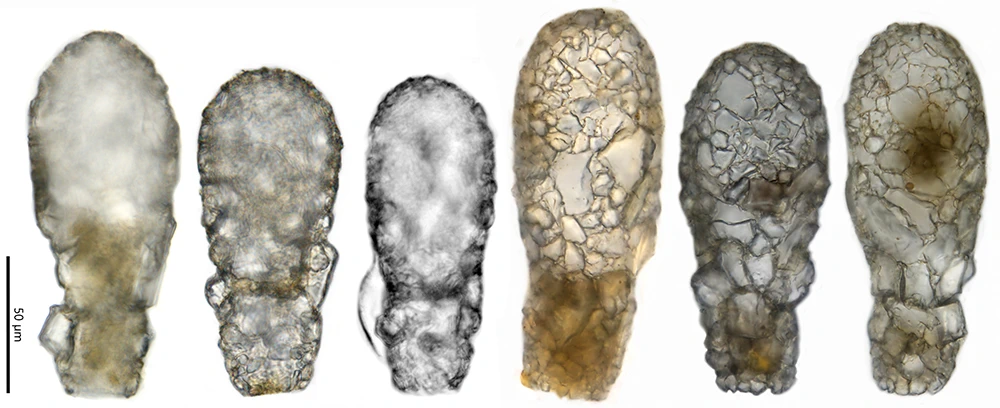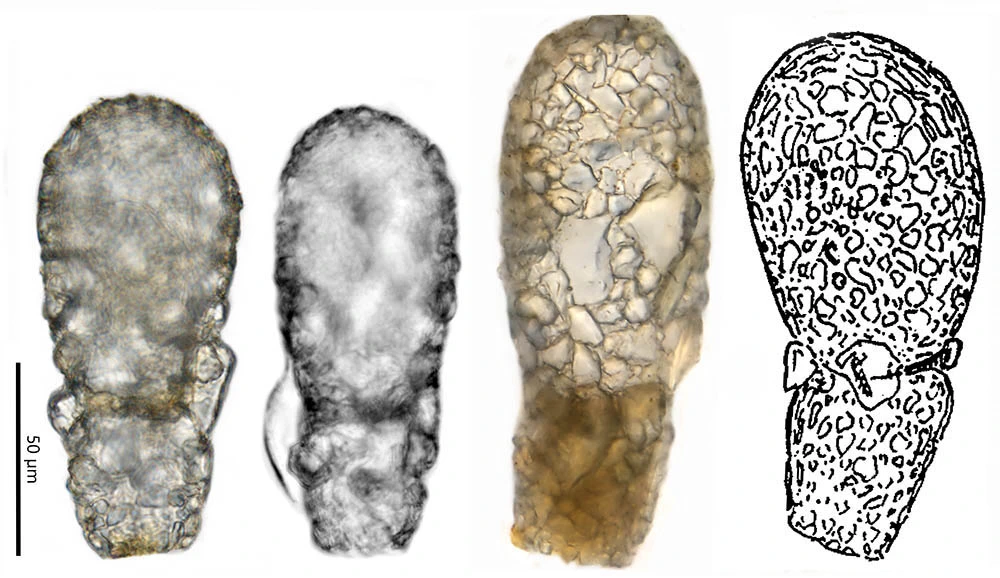
Lagenodifflugia bryophila Penard, 1902
Diagnosis: Shell elongated, almost tubular, barely or not at all compressed, chitinoid, yellowish or brownish, covered with more or less large flattened particles depending on the individual. It is generally slightly arched, but this curvature is very slight, and there are individuals where it seems to be completely lacking. There is a characteristic septum with a central internal aperture between neck and main body. The location of this septum is indicated by an incision between the neck and the main body, but this incision is not always easily visible when it is covered by several large mineral grains. Plasma never contains zoochlorellae. The pseudopodia are flowing, lively, often branched, lobed and serrated, or there is only one, very elongated, sometimes with another very small at its side. These pseudopodia are particularly tenacious here, and adhere to the surface with force. Nucleus spherical and filled with small nucleoli. There is at least one contractile vesicle, which is rarely visible.
Dimensions: Penard (1902): Length 100-125 µm. My measurements: Length 122-141 µm. (n=6, Croatia, cave); Length 109-121 µm (n=8, Bhutan).
Ecology: Freshwater. Sediment, also in caves (Croatia)
Geographical distribution: Probably cosmopolitan.
Remarks: Carefully distinguish this species from similar shells, as the incision between neck and main body is often obscured by some larger mineral grains.