
M. socialis, young and older cell – Gaasterland. Netherlands, 2022
Microgromia socialis Hertwig & Lesser, 1874
Diagnosis: Shell ovoid or nearly spherical, with a short tubular neck. Pseudopodia long, branching and anastomosing, arising from a peduncle at the aperture. Nucleus spherical, with central nucleolus; nucleus relatively large. Contractile vacuole near aperture. Often numerous individuals are grouped into a colony, fusing granulopodia; multiplication by fission and also by swarmers.
Dimensions: Diameter 20-35 µm. My measurements: 11.1 – 15.3 µm (mean 11.6 µm); nucleus c. 5 µm.
Ecology: Fresh water, different water types; in sediments and among vegetation.
Remarks: It is not clear if there is one species or that the species name covers several species. I think that the latter is true.
>

M. socialis, Gaasterland. Netherlands, 2022

M. socialis, Pyrenees, 2021

M. socialis, Pyrenees, 2021

M. socialis, the same cell as above – Pyrenees, 2021

M. socialis, Pyrenees, 2021

The brown cell is an older cell, probably the mother-cell

Network of granulopodia

Network of granulopodia
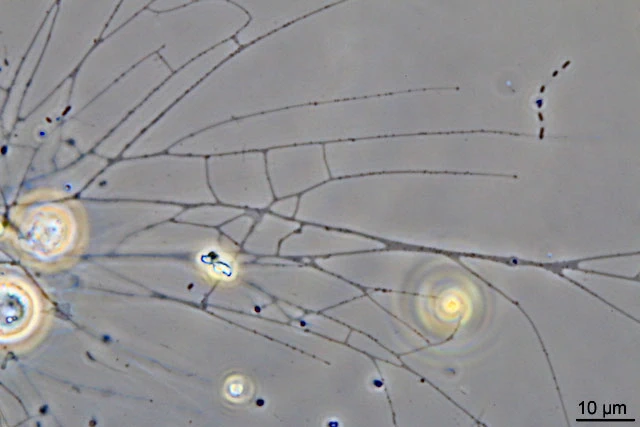
Network of granulopodia, detail; slow bidirectional streaming of granules.
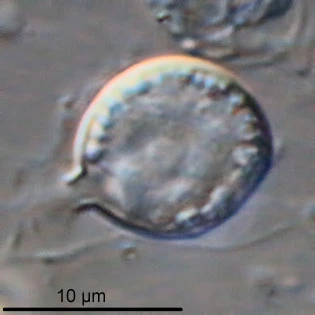

Spherical and ovoid shaped shells


M. socialis, after Hertwig, 1874.