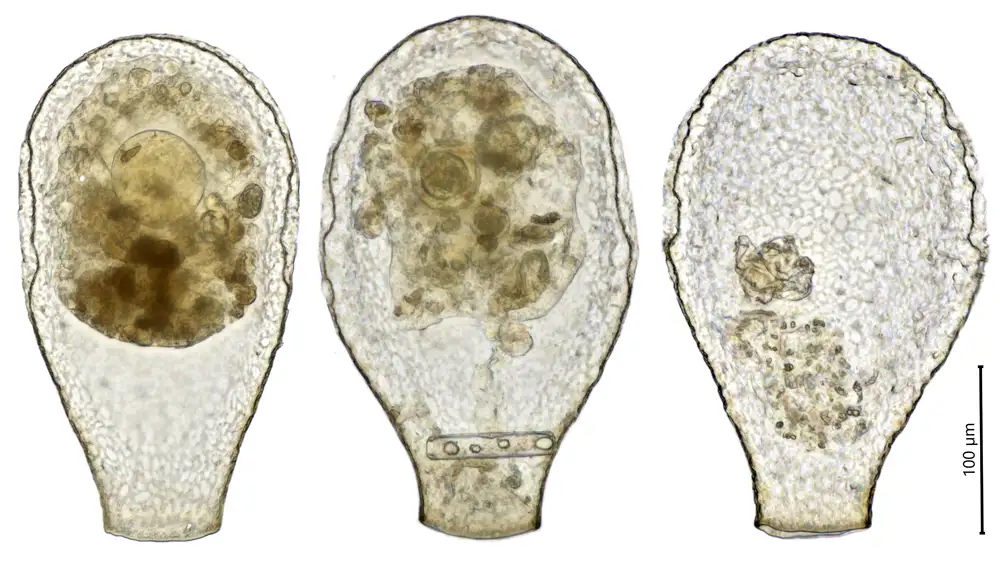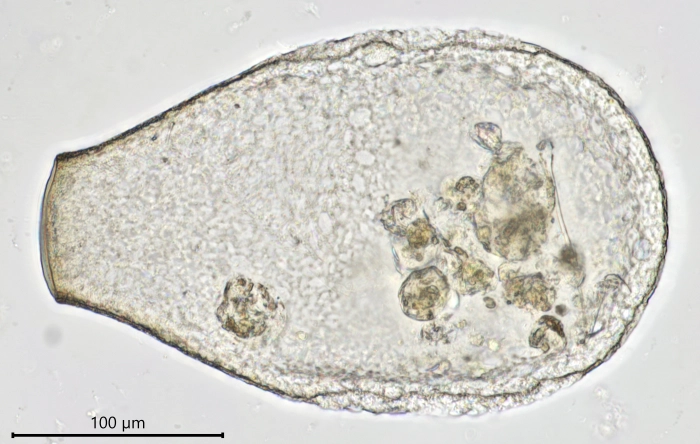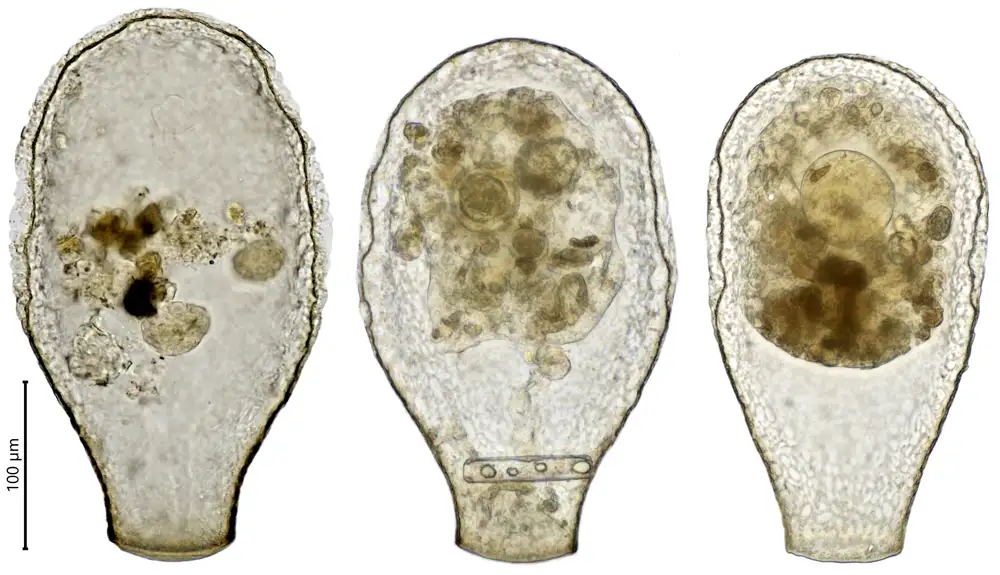
Planocarina maxima (Awerintzew, 1906) Kosakyan et al., 2016
Basionym: Nebela maxima Awerintzew, 1906
Diagnosis: The shell is very large, pear‑shaped, and not compressed along the longitudinal axis. Its yellowish coloration and general outline may recall Planocarina carinata, but it differs clearly from that species in both size and shape. Most characteristic is the irregular, notched, almost folded keel that borders the upper and middle third of the shell on one side, or in some specimens only the middle third.
The keel consists predominantly of organic material, with only occasional small siliceous plates embedded within it.
Its development is variable: in some individuals the keel is well developed, whereas in others it is weak or nearly absent. In the same waterbody, shells may occur that are otherwise identical to P. maxima but completely lack a keel, with only faint traces detectable upon close examination. One specimen was observed in which the keel began directly at the oral aperture.
Thanks to the considerable size of the shell, the individual siliceous plates that form its upper layer do not touch one another at their edges, and significant gaps remain between them, through which the oral aperture can be observed very easily. The “oral” opening has the shape of a slightly elongated circle; its edges are somewhat thickened and appear to be bent outward, raised quite strongly. A single contractile vacuole.
(Original Russian description translated and modernized into English by Copilot.)
Dimensions: According to Awerintzew (1906): shell length 280-325 µm. Irish specimens: length 289—314 µm (n = 15).
Ecology: Sphagnum vegetation.
Distribution: Arkhangelsk, Russia (Awerintzew, 1906); England (Heal, 1961, 1964), Iceland (Decloitre, 1965), Ireland (Siemensma, 2025, unpubl.).