Thecochaos fibrillosum (Penard, 1902) Page, 1981
Fred C. Page re-examined naked amoebae in the Penard Collection in the Natural History Museum in London, 1981. He made following remarks upon the slides of Amoeba alba:
Penard, 1913; mentioned in Penard, 1902, pages 123,124.
Slide numbers. 20.12.8.7 (labelled Amoeba alba ‘avec 1 Amoeba fibrillosa‘); 20.12.8.8. Total number of amoebae 5.
Description and remarks. These multinucleate amoebae have the wrinkled pellicle and general form of a Thecamoeba, even though the form shows a greater variety and, even in the fixed preparations, evidence of a greater fluidity than that of the more typically Thecamoeba-like Amoeba alba. In this respect it may be compared with Thecamoeba proteoides Page, 1976 (Page, 1976, 1977). Long, slender forms occur, sometimes with temporary branching (which can, however, occur occasionally even in the more rigid A. alba. Undoubtedly this temporary branching is associated only with a change of direction. Further comments on this character will be found in both Greeff (1891) and Penard (1913).
The largest of these amoebae is that on slide 20.12.8.7, which is 320 um long though certainly not in the most extended form possible. The lengths of the other four are 228 um, 228 um, 226 um, and 158 um, this last one an irregular form. The length : breadth ratio of the larger amoeba in Fig. 43 is 4:1, ignoring the lateral pseudopodium near the posterior end, which was probably being withdrawn at the time of fixation. In Fig. 42, the pseudopodium with the hyaline cap (arrow) was undoubtedly the active one, with the other branch being withdrawn in a change of direction at the time of fixation.
In the large amoeba in Fig. 41, 97 nuclei were counted, and in another amoeba 85 could be found. Both these numbers undoubtedly err on the low side.
Although Penard (1913) said that the nuclei are ‘normalement globuleux’ though fairly often elongate, the elongated condition appears normal in these preparations (Fig. 44). Furthermore, observations while focussing suggest that many if not all the more spherical and ovoid forms (Fig. 45) are actually due to polar and oblique views of elongate nuclei. The single central nucleolus has in general the shape of the nucleus, though it often appears even more elongate (with long sides straighter) than does the nucleus. It is sometimes constricted in the middle to a dumbbell-like shape, which appears to be merely another variation and not a prelude to division as Penard (1913) thought.
The measurements of 25 nuclei in the largest amoeba ranged from 7.0 x 6.2 µm to 10.8 x 7.0 µm, with a mean greatest dimension of 8.9 µm.
A food vacuole in one amoeba contains an ingested organism which appears to be an amoeba, itself containing truncately bipyramidal crystals. Another amoeba also contains an ingested organism which appears to be a protozoon.
Greeff (1891) did not publish any illustrations of this species. (See remarks on A. alba.) Although I accept that this may well be the same species which Greeff saw, it must be pointed out that Greeff did not consider the nuclei to be elongate but described them as ‘in der Regel rund, zuweilen leicht oval’. However, his description of the amoeba as a whole corresponds with this material. Since Greeffs description of Amoeba fibrillosa precedes in the same publication his description of A. alba the former will be the type-species of the new genus being erected for the two. Penard, it will be noted, had more fixed material of A alba, if this collection is representative.
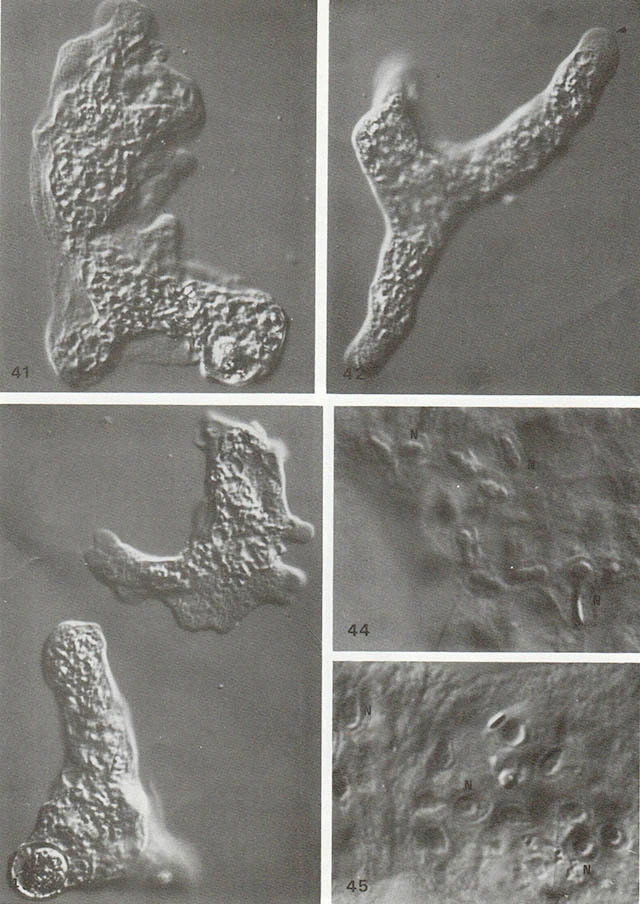
Figs 41-45 Amoeba fibrillosa (= Thecochaos fibrillosum comb. nov.). (41) to (43) Whole cells; arrow indicates hyaline cap on main pseudopodium in (42) x 250. (44), (45) Nuclei x 1000. N = nucleus.
From:
Page, FC, 1981. Eugène Penard’s slides of Gymnamoebia: re-examination and taxonomic evaluation. Bull. Br. Mus. nat. Hist. (Zool.), 40,1:1-32