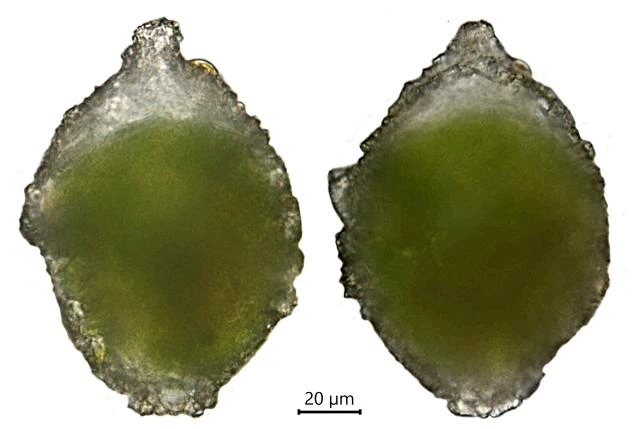
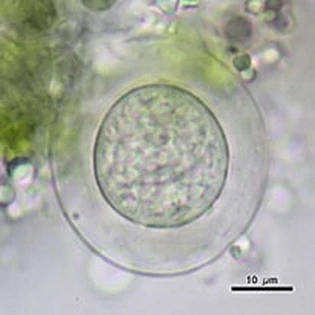
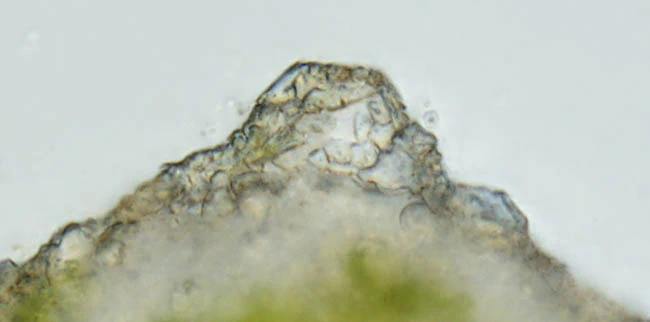
Difflugia difficilis Thomas, 1954
Diagnosis: Shell ovoid, circular in cross-section. Aboral end of the test commonly with a not prominent, but rounded and/or compressed protuberance, sometimes replaced by a foreign body (diatom) which acts as the absent horn. The sides of the test converge towards the pseudostome to end in a short collar; the pseudostome is circular with a diameter varying between one-half and two-thirds of the width of the test. Shell hyaline, clear, coated with siliceous particles, arranged regularly. Nucleus vesicular, spherical, with one central nucleolus. Zoochlorellae present.
Dimensions: Thomas (1954): Length 83-93 µm; width 59-66 μm; aperture 20-27 µm; height of the collar, 6-9 μm.
My measurements:
Naardermeer, ditches: Length 80-117 µm; width 54-78 µm; aperture 26-32 µm; collar 4.7-7.4 µm high (n=6); nucleus 18.5-22.9 µm (n=2).
Hartwerd, ditch: Length119-162 µm; width 85-99 µm; aperture 27-36 µm (n=12); nucleus 31.5-34.2 µm (n=2).
Den Treek: Length 111-151 µm (n=20); nucleus 36 µm (n=1)
Epen, meadow pond: Length 88-126 (n=3).
Ecology: Freshwater, sediment; France (Thomas, 1954), Belgium (Chardez, 1956), Africa (Gauthier-Lièvre & Thomas, 1958), Netherlands (in sediment of mesotrophic and eutrophic waters; 2019-2025).
Remarks: I found four populations which differed in size (see above). The Hartwerd population was found in a ditch near the village of Hartwerd in the nothern part of the Netherlands and the Epen population in a meadow pond in the southern part.