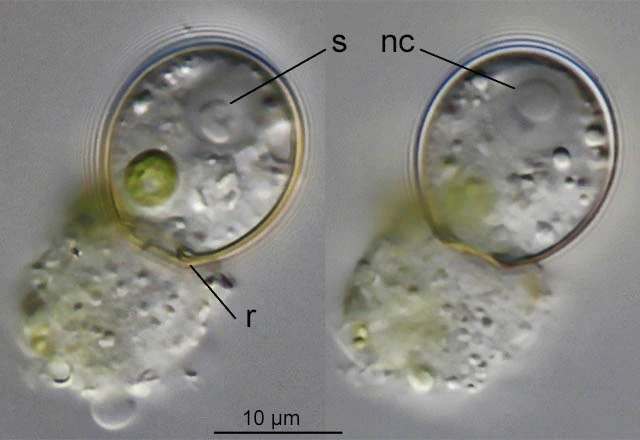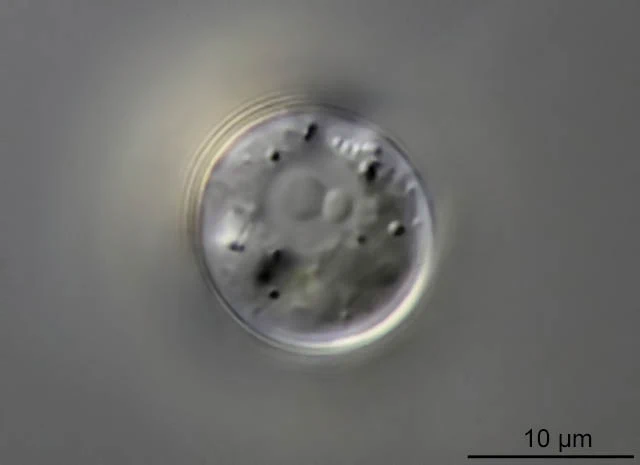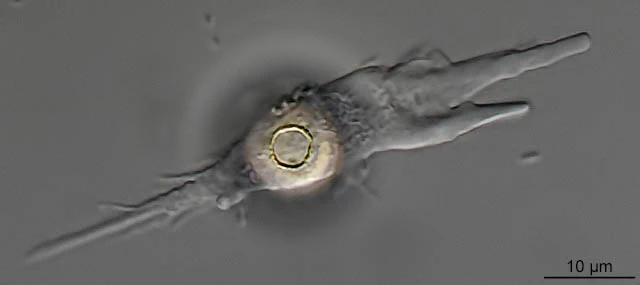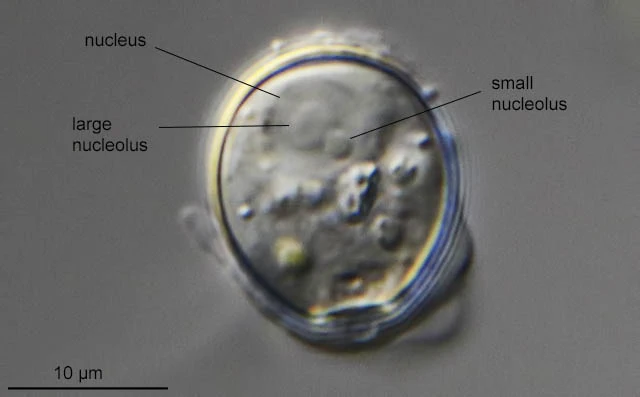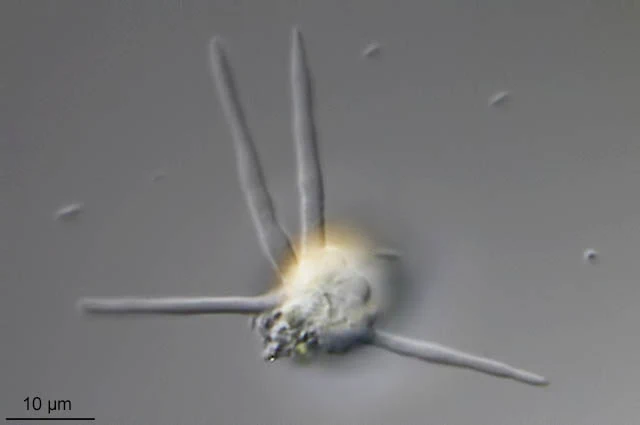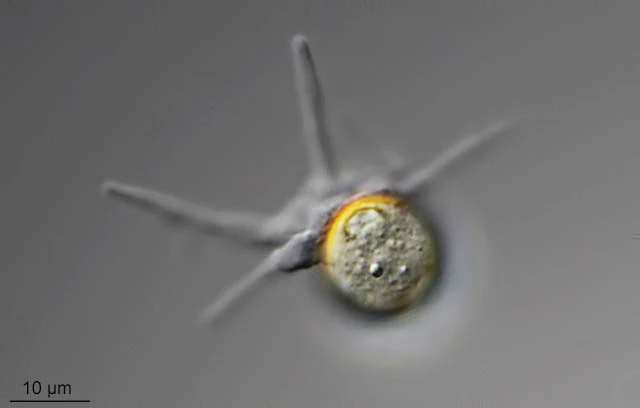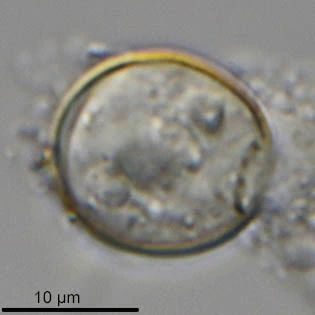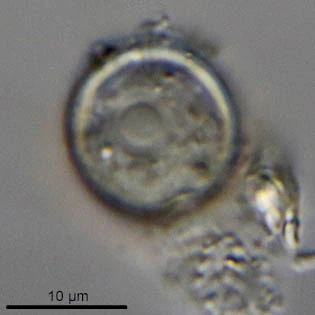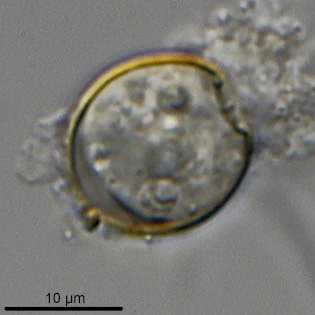

Cryptodifflugia sp.
Material: Sample collected in 2018 from moss growing on a tree, ca. 1 km from the cabin used as Fidel Castro’s command post in 1958 (Cuba). Moss rinsed with demineralized water; resulting suspension stored with sediment. Specimens observed in wet mounts and in the sediment, where the species multiplied readily.
Diagnosis: Shell small, ovoid to almost spherical; specimens frequently carrying debris around the aperture. Nucleus notable for the presence of a second, smaller body situated between the central nucleolus and the nucleolar membrane (eccentric “nucleolus” or nucleolar body).
Dimensions: Shell length 16.0–18.1 µm; breadth 14.5–15.6 µm; L/B ratio 1.1–1.2.
Aperture diameter 3.8–4.5 µm.
Nucleus 6.0–6.4 µm; central nucleolus 3.2–3.4 µm; eccentric nucleolar body 0.9–1.6 µm (n = 4).
Ecology: Thrives in wet moss rinsates; multiplies both in sediment and in wet mounts.
Distribution: Known only from the type locality (Cuba).
Remarks: The combination of nearly spherical shell shape, persistent debris accumulation around the aperture, and the presence of a secondary nucleolar body is unusual within Cryptodifflugia. Further material is needed to determine whether this represents an undescribed species or an atypical population of a known taxon.