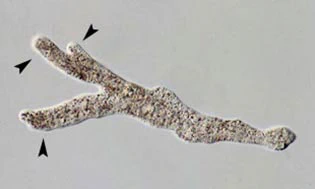
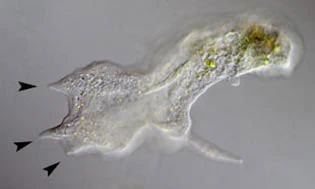
Morphology
When you observe an amoeba in a freshly prepared wet mount under the light microscope, it has usually been disturbed by its transfer from the sample jar onto the slide. For several minutes, or even for several hours depending on the species, it does not truly move and assumes a rounded, irregular, or even star‑shaped form. It bulges, turns, or remains immobile in this stationary form, also referred to as non‑directed locomotion.
Disturbed amoebae may also float. They typically show a more or less star‑shaped body with several pseudopodia radiating from the central mass. These floating forms are characteristic of certain taxa.


After some time, an amoeba in a stationary or floating form begins to move, and during continuous directional locomotion it maintains a characteristic shape until it stops or changes direction. During movement the shape undergoes minor changes, but this stable locomotive form of an actively, continuously moving amoeba is highly characteristic and can be used as a taxonomic feature.

The main mass of the cytoplasm, the granuloplasm, contains optically visible granules, crystals, and other inclusions. During locomotion, the leading edge of the cell shows an area of transparent hyaloplasm, which appears as clear as water. This anterior hyaloplasm forms a hyaline crescent, commonly referred to as the hyaline cap.
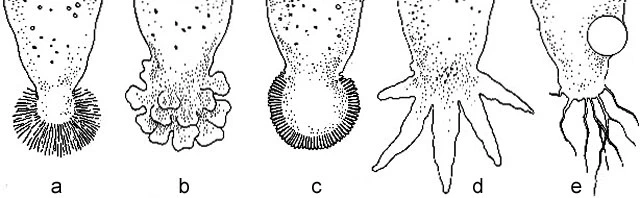
While the hyaline cap forms the anterior part, the uroid constitutes the posterior end of a locomotive amoeba. In many species the uroid has a distinct, characteristic morphology. Uroids may be hairy, morulate, or rounded. Some species, such as Rhizamoeba, show trailing filaments resulting from sticky contact with the substrate.
Pseudopodia
Amoebae without distinct pseudopodia are usually monopodial. The cell is cylindrical or sub‑cylindrical and behaves as a single large pseudopodium. It may extend a lateral pseudopodium when changing direction. The term monotactic or limax form is applied to amoebae that are consistently monopodial.
Cylindrical or sub‑cylindrical amoebae that form several distinct pseudopodia are called polypodial. These cells may be hand‑shaped (palmate), with the pseudopodia acting as “fingers”. Polypodial amoebae may adopt a monopodial form when actively moving at high speed. Distinguishing between monopodial and polypodial forms is only meaningful in amoebae advancing in a constant direction.
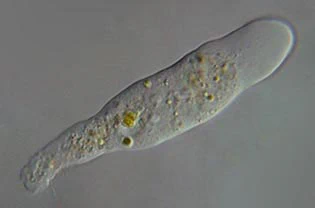
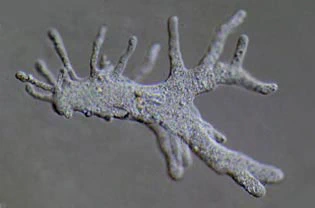
Most small and medium‑sized amoebae do not form distinct pseudopodia but instead produce small hyaline projections without locomotive function, known as subpseudopodia. They are entirely hyaline and may have various shapes. Mayorella species have characteristic conical subpseudopodia.
Some amoebae show folds on the dorsal surface of the locomotive form. Large amoebae may also have folds or wings on their lateral surfaces.