The major organelle of an amoeba is the nucleus. Its main function is to direct cellular activities—such as reproduction, feeding, and growth—by regulating the production of specific enzymes that drive the cell’s biochemical reactions. The nucleus contains the amoeba’s DNA, the “blueprint” for cellular function, which instructs the cell how to synthesize these enzymes.
Each amoeboid cell contains at least one nucleus, and larger cells are often multinucleate. The morphology, size, and number of nuclei can serve as useful differential characters. According to the classification of Raikov (1982), two principal types of nuclei occur in amoebae:
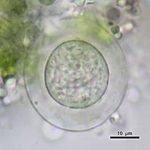
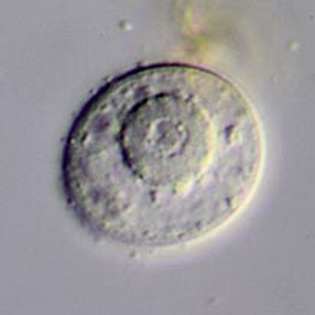
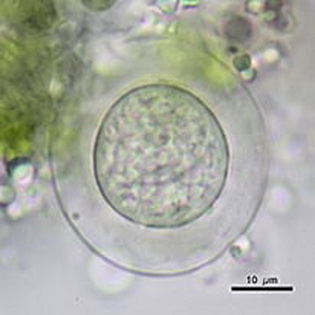
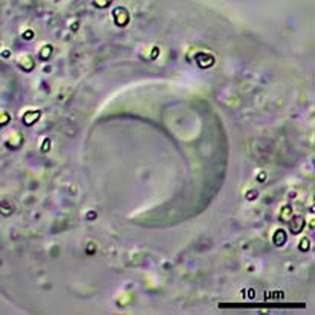
Vesicular nuclei, with one usually central nucleolus, sometimes accompanied by a few very small additional nucleoli.
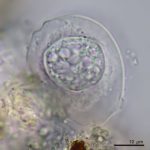
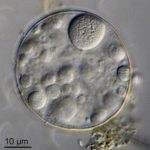
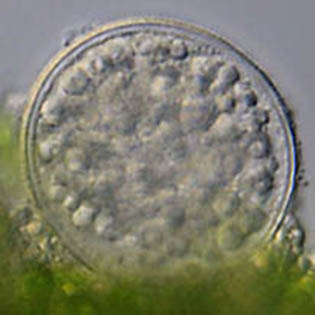
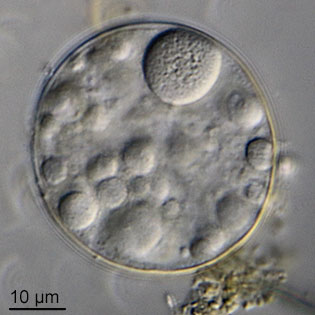
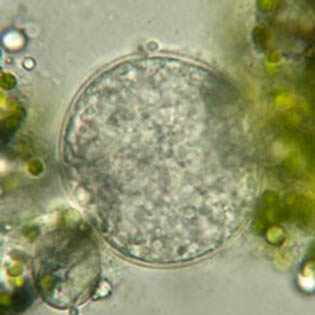
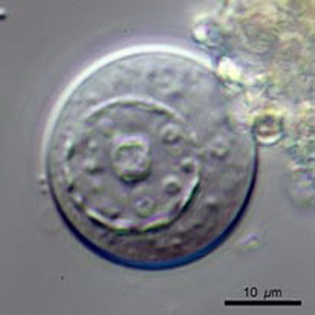
Ovular nuclei, containing several to many small nucleoli (Fig. 1).
Difflugia biconcava
Netzelia gramen
Difflugia lobostoma
Difflugia distenda
Fig. 1. Left: vesicular nuclei of Difflugia biconcava and Netzelia gramen. Right: ovular nuclei of Difflugia amphora and D. distenda.
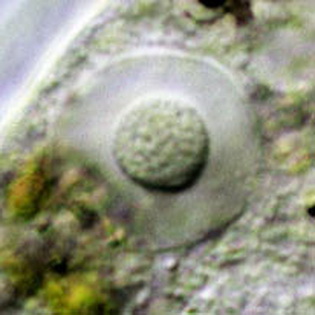
Below: photomicrographs of some characteristic nuclei:
Difflugia elegans
Difflugia nodosa
Difflugia pyriformis
Difflugia amphora
Difflugia bidens
Difflugia distenda
Cucurbitella vlasinensis
Netzelia gramen
Netzelia gramen
Difflugia lobostoma
Difflugia lobostoma
Difflugia lobostoma
Difflugia biconcava
Difflugia urceolata
Difflugia urceolata
Difflugia capreolata
Polychaos dubium
Polychaos annulatum
Cucurbitella mespiliformis
Difflugia microclaviformis
Trichamoeba sinuosa
Amoeba proteus
Mayorella augusta
Ferry Siemensma, created March 2, 2019; last modified May 11, 2026