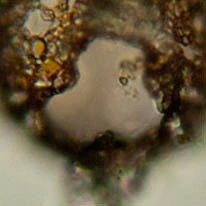
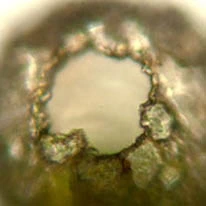
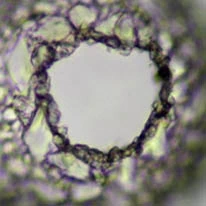
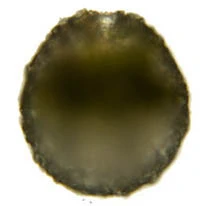
Netzelia lobostoma (Leidy, 1874) Gonzales-Miguens et al, 2021
Basionym: Difflugia lobostoma Leidy, 1874
Syn.: Difflugia proteiformis Lamarck, 1816
Syn.: Cucurbitella tricuspis Carter, 1856, Medioli et al., 1987.
Syn.: Difflugia tricuspis Carter, 1856
Diagnosis: Shell ovoid or subspherical, circular in cross section. Shell composed of small and medium-sized quartz particles, bound together by organic cement. Aperture variable in shape: trilobed, four-lobed, or irregular with indistinct lobes, bordered by an irregular raised ridge of small particles. Lobes range from squarish to curved. Aperture often with an indication of a collar. Nucleus with several small nucleoli. Zoochlorellae may be present.
Dimensions: Ogden (1980): shell length 123-186 µm;
Penard (1902): length 140-170 µm;
Siemensma (Arcella.nl, 2026): length 136-192 µm, nucleus 37-49 µm.
Ecology: Freshwater, among aquatic plants.
Geographical distribution: Probably cosmapolitan.
Remarks: Netzelia lobostoma is considerably larger than N. gramen, but based on the shape and structure of the test, this species is difficult to separate from the latter. The key character is the shape and structure of the nucleus, which differs completely from that of N. gramen. In practice, however, this character is often not very useful, as one has to press the cover slip to break the test. If you are lucky, the nucleus becomes visible—if it emerges from the broken test.