Netzelia tuberculata (Wallich, 1864)
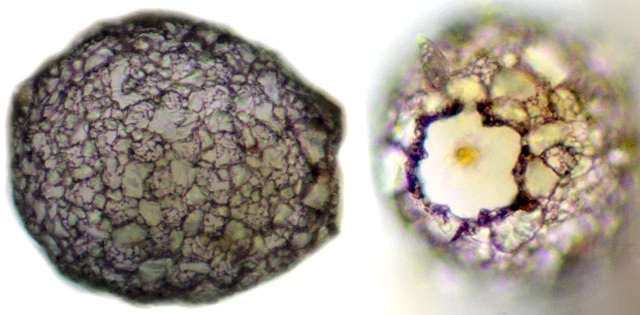
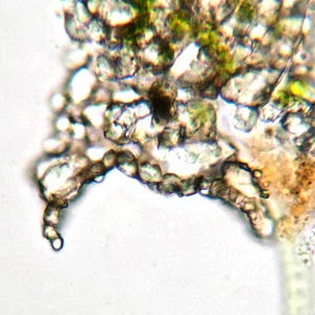
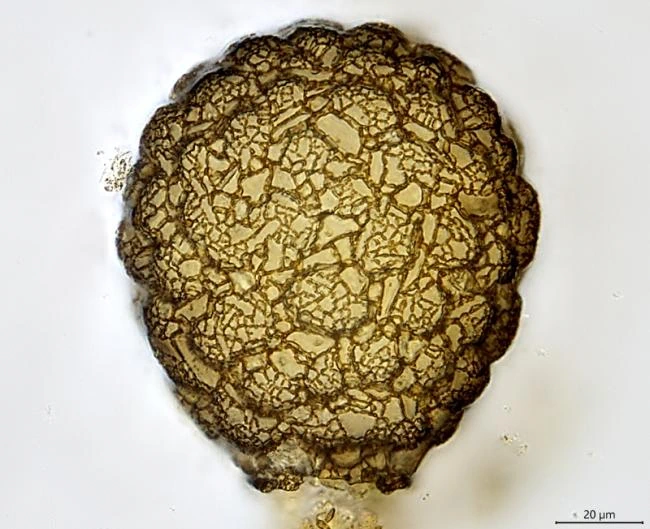
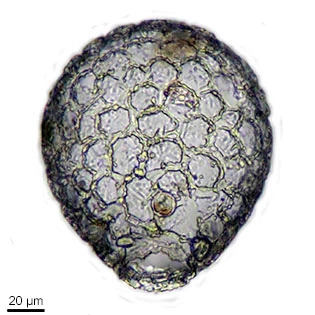
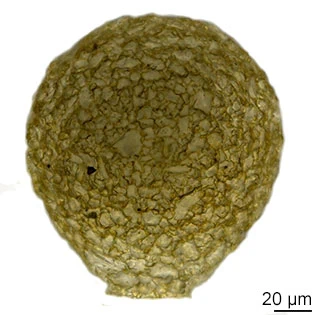
Diagnosis: Shell ovoid to nearly globular, composed of quartz particles or diatom frustules or a mixture of both; outline of the test characterized by typical protuberances, giving the shell a raspberry-like appearance; protuberances not always clearly present; particles bounded by an organic cement matrix with a network structure; aperture irregular with an hexagonal or heptagonal appearance, often with pointed or tooth-like projections. Collar narrow and composed of small mineral elements. Nucleus spherical with granular nucleolar material.
Dimensions: My observations: 110-206 µm, mean 138 µm; nucleus 31-38 µm.
Remarks: Ogden (1980) creates a new name, Difflugia wailesi, for smaller specimens with a smooth outline and mainly composed of diatom frustules, earlier described as Difflugia tuberculata var. minor by Wailes (1919). In a later paper Ogden (1983), in contradiction to his earlier description, describes specimens of D. wailesi with shells mainly composed of flat pieces of quartz. He highlights the difficulty of differentiating the two species, based on the similarity of dimensions between specimens from several locations (e.g. 96-112 µm for D. wailesi and 96-116 µm for D. tuberculata).
The raspberry-like structure of Netzelia tuberculata is not always present. Even specimens from the same sample can have a raspberry-like structure or not. This tubercular structure is sometimes also present in specimens of Difflugia corona. This indicates that both species are related. It also indicates that the tubercular structure is not a key-characteristic.
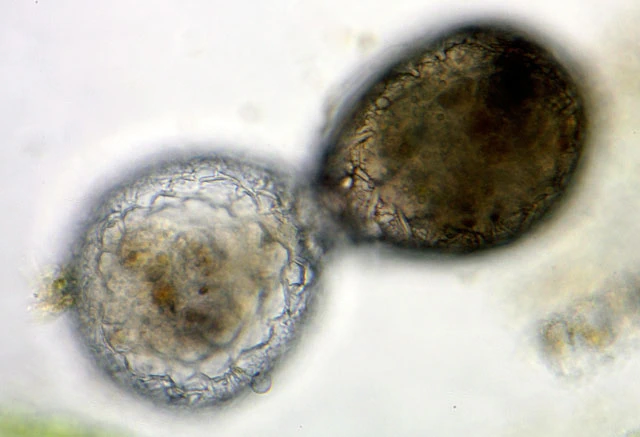
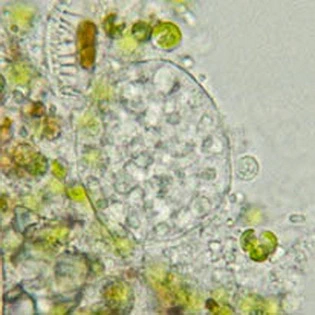
In the summer of 2012 I observed the division of a specimen with a smooth outline (see the photomicrograph below). The new shell however had a tubercular structure!