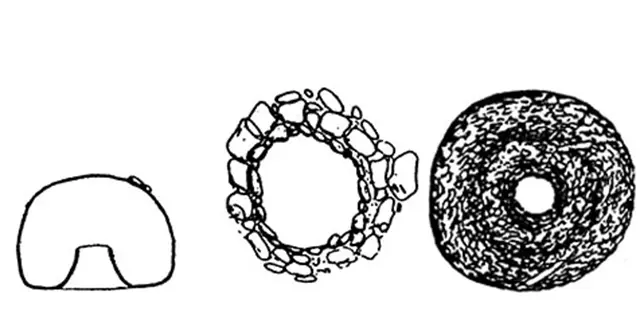
Cyclopyxis stephanostoma Bonnet, 1980
Diagnosis. Shell clearly circular in dorsal view and 3/4 spherical. Reduced aperture, located at the top of an abrupt funnel, generally cylindrical, or more rarely infundibuliform. Internal extremity of the funnel sometimes slightly flared, always lined internally by a crown of regular, refractive, smooth-edged siliceous platelets, smaller than the irregular plates of the wall of the funnel. In ventral view, the double contour of the pseudostome is clearly visible. Shell embedded with plates of amorphous silica, always reworked, superimposed slightly, sometimes irregular, of the Heleopera petricola type, with possibly reworked remnants of diatoms, sometimes regular and identical, and from ingested euglyphids. The dorsal aspect is similar to Cyclopyxis machadoi Bonnet 1965 or Cyclopyxis dulcis Coûteaux and Munsch 1978.
Dimensions: According to Bonnet (1980): Shell diameter: 119—137 μm; height average 89.5 μm; aperture 23—28 μm.
Ecology: Acid tropical forest soils.
Geographical distribution: Paraguay and Philippines.
Remarks: This species is distinguished from: a) Cyclopyxis puteus Thomas, 1960 by the presence of the crown of refractive siliceous elements; (b) from C. machadoi Bonnet, 1965 by the absence of festoons and vestibular teeth; c) from C. dulcis Coûteaux and Munsch, 1978 by the tubular form of the invagination, the regularity of the elements of the crown and the test.