| 1 | Cross-section of shell and aperture are round | 3 |
| 1’ | Shell and aperture are different | 2 |
| 2 | Cross-section of shell elliptical, aperture round | 33 |
| 2’ | Cross-section of shell elliptical, aperture elliptical | 48 |
| 2'' | Shell not round or elliptical, but more or less flattened, especially at the anterior part; with a curved mouth |  E. symoensi |
| 3 | Shell with spines, which are outgrowths of the scales | 4 |
| 3’ | Shell without spines | 22 |
| 4 | Spines located exclusively in the anterior, middle or apical part of the shell (they can be collected in a bundle or tuft) | 5 |
| 4’ | Spines more or less evenly distributed over the entire surface of the shell | 11 |
| 5 | Spines directed backwards located in the anterior or middle part of the shell | 6 |
| 5’ | Spines located in the apical part of the shell | 7 |
| 6 | Spines located in the anterior part of the shell |  E. brachiata |
| 6’ | Spines located in the middle part of the shell |  E. brachiata librata |
| 7 | Spines in the apical part are few (=< 2) | 8 |
| 7’ | Spines in the apical part are numerous (> 2), bundled in a tuft | 10 |
| 8 | Shell length < 100 µm | 9 |
| 8’ | Shell larger than | 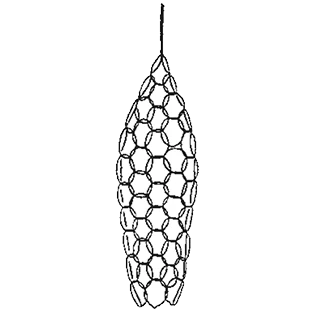 E. mucronata |
| 9 | Shell ovoid |  E. acanthophora cirrata |
| 9’ | Shell cylindrical | 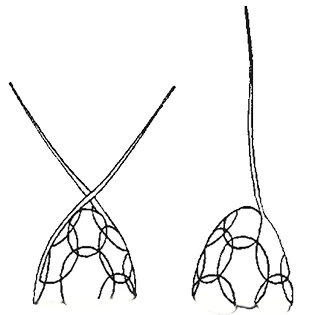 E. cristata acicularis |
| 10 | Shell cylindrical, with a slightly marked neck | 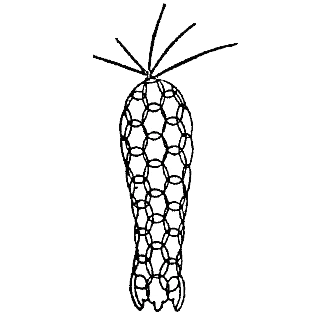 E. cristata |
| 10’ | Shell lanceolate, without narrowing or neck |  E. cristata lanceolata |
| 11 | Body scales round or oval with a smooth edge | 12 |
| 11’ | Body scales have a papillary formation on the anterior and posterior edge, which can be located in a small notch | 14 |
| 12 | Apertural scales with one medial and 4-5 lateral teeth | 16 |
| 12’ | Scales of different shape | 13 |
| 13 | Apertural scales pointed, entire |  E. gauthieri |
| 13’ | Apertural scales semicircular, finely toothed |  E. hutchinsoni |
| 14 | Papillary formation on body scales located in shallow notches | 15 |
| 14’ | Notches absent, shell elongated ovoid |  E. crenulata minor |
| 14'' | Notches absent, shell almost spherical | 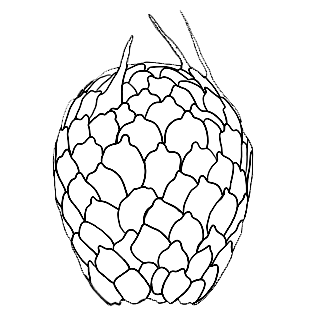 E. cabrolae |
| 15 | Shell elongated-ovate | 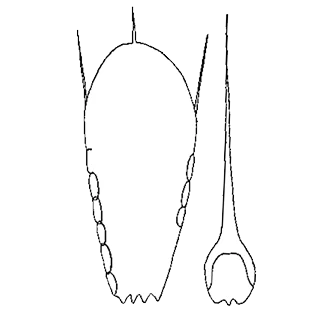 E. crenulata |
| 15’ | Shell cylindrical |  E. crenulata elongata |
| 16 | Spines directed forward |  E. acanthophora equeis |
| 16’ | Spines directed backwards | 17 |
| 17 | Curved spines |  E. acanthophora flexuosa |
| 17’ | Straight spines | 18 |
| 18 | Spines of different lengths | 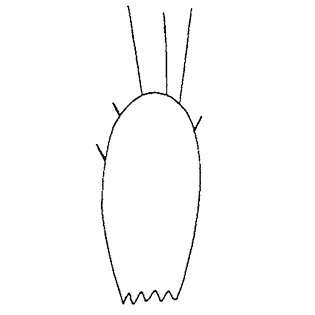 E. acanthophora heterospina |
| 18’ | Spines identical | 19 |
| 19 | Number of spines not more than 2 | 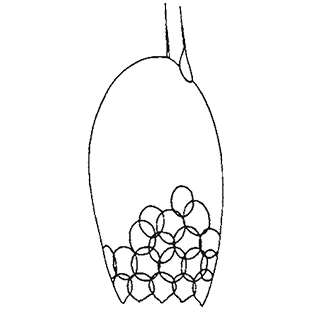 E. acanthophora deflandrei |
| 19’ | More than 20 spines | 20 |
| 20 | Short spines |  E. acanthophora brevispina |
| 20’ | Long spines | 21 |
| 21 | Shell ovoid | 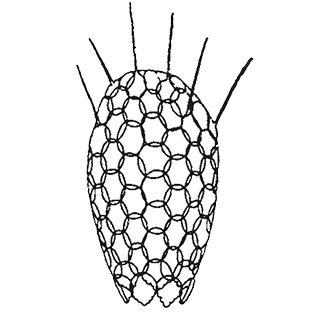 E. acanthophora |
| 21’ | Shell cylindrical |  E. acanthophora cylindrасеа |
| 22 | Body scales round or oval without notches or papillae | 25 |
| 22’ | Body scales have notches or papillary formations | 23 |
| 23 | Shell more than 100 µm long, the anterior edge of the body scales is flat, bears a rounded and shallow notch, the posterior edge has a raised, pointed thickening in the form of a rib |  E. aspera |
| 23’ | Shell less than 100 µm long, body scales have papillary formations | 24 |
| 24 | The papillary formation is located only on the anterior edge of the body scales |  E. scutigera |
| 24’ | The papillary formation is located both on the anterior and posterior margins of the body scales | E. crenulata minor |
| 25 | Apertural scales are polygonal | 26 |
| 25’ | Apertural scales are oval | 28 |
| 26 | Apertural scales are rhombic | 27 |
| 26’ | Apertural scales are hexagonal |  E. hyalina |
| 27 | Shell length less than 70 µm |  E. cristata decora |
| 27’ | Shell length more than 70 µm |  E. cristata major |
| 28 | Apertural scales are oval with a small triangular medial tooth and 4-5 lateral | 29 |
| 28’ | Apertural scales are drop-shaped, consisting of two parts: a small oval one directed into the lumen of the aperture and bearing 5 small spines, and a large oval one attached to the body scales | 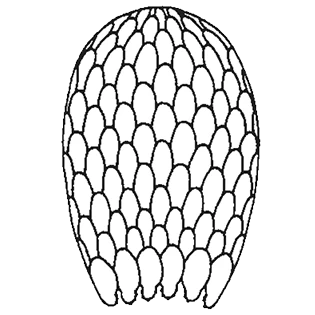 E. capsiosa |
| 29 | Shell oval | 30 |
| 29’ | Shell shape different | 31 |
| 30 | Shell length is less than 40 µm |  E. tuberculata minor |
| 30’ | Shell is more than 40 µm long |  E. tuberculata ovoidea |
| 31 | Shell curved in the area of the mouth |  E. tuberculata curvata |
| З1 | Shell not curved | 32 |
| 32 | Shell elongated-ovate |  E. tuberculata |
| 32’ | Shell elongated-cylindrical |  E. tuberculata subcylindrica |
| 33 | The shell has spines | 34 |
| 33’ | The shell does not have spines | 42 |
| 34 | The spines are located more or less evenly over the entire surface of the shell | |
| SCALES | ||
| 34 | Spines of varying length are located on the apical part of the shell in the form of a bundle |  E. bryophila |
| 35 | Apertural scales are almost triangular, form a clearly visible thickened row | 36 |
| 35' | Apertural scales are of a different shape, do not form a thickened row | 38 |
| 36 | Length of the spines is the same | 37 |
| 36' | Spines of varying length |  E. strigosa heterospina |
| 37 | Shell ovoid |  E. strigosa |
| 37' | Shell broadly pear-shaped |  E. strigosa muscorum |
| 38 | The entire surface of Shell covered with numerous spines | 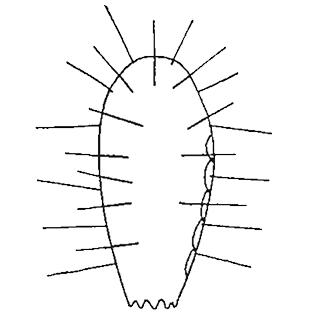 E. filifera spinosa |
| 38’ | The spines are few in number, located mainly in the back of the shell | 39 |
| 39 | Shell elongated-oval | 40 |
| 39’ | The shape of Shell different | 41 |
| 40 | The length of Shell less than 100 µm | 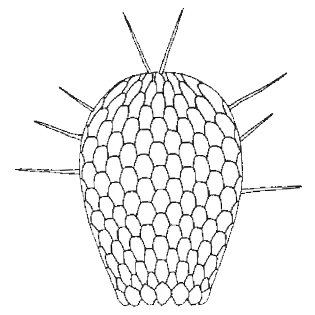 E. filifera |
| 40’ | Shell length more than 100 µm |  E. filifera magna |
| 41 | Shell pear-shaped |  E. filifera pyriformis |
| 41’ | Shell cylindrical | 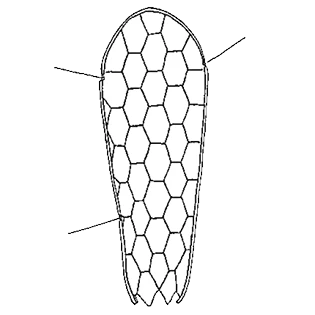 E. filifera cylindracea |
| 42 | Apertural scales oval | 43 |
| 42’ | Apertural scales of a different shape | 47 |
| 43 | Shell oval, the sides are almost parallel | 44 |
| 43’ | Shell ovoid | 45 |
| 44 | Shell length not more than 20 µm |  E. anodonta |
| 44’ | Shell more than 20 µm long |  E. anodonta magna |
| 45 | Shell curved |  E. rotunda obliqua |
| 45’ | Shell not curved | 46 |
| 46 | Shell is radially symmetrical, moderately flattened | 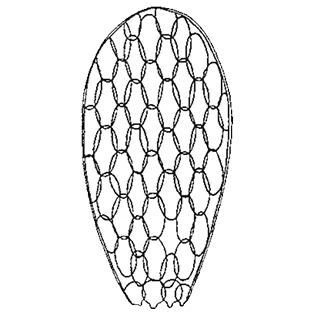 E. rotunda |
| 46’ | Shell bilaterally symmetrical (the ventral side is flattened, the dorsal side is slightly curved) |  E. rotunda dorsalis |
| 47 | Apertural scales almost triangular, forming a clearly visible thickened row |  E. strigosa glabra |
| 47’ | Apertural scales lanceolate, consisting of two parts, on the side facing the Apertural cavity there is 1 large and 4 tiny spines |  E. simplex |
| 48 | Shell with spines | 49 |
| 48’ | Shell without spines | 51 |
| 49 | Shell medium or relatively large (40-100 µm), ovoid with a somewhat elongated anterior end, the spines are short, often paired, located along the lateral border or along the entire length of the shell | 50 |
| 49' | Shell 70-100 µm, pyriform, with short and thick spines, but never very numerous. Body scales very elongated, and very regular, as found in genus Assulina. | 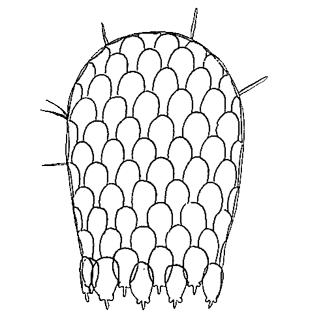 E. leclercqi |
| 49’' | Shell larger, oval, lenticular in profile, strongly flattened, the spines are short, located along the lateral border |  E. compressa |
| 50 | The length of the spines is the same | 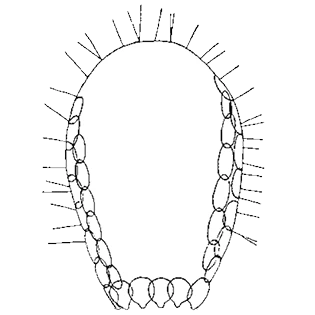 E. ciliata |
| 50’ | The spines are of different lengths | 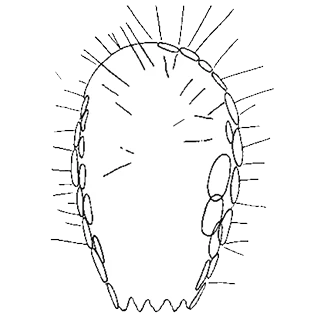 E. ciliata heterospina |
| 51 | In profile along the edge of the shell there is a clearly visible row of evenly spaced body scales of the same size |  E. marginata |
| 51’ | The marginal row of body scales is absent | 52 |
| 52 | Apertural scales not always equally pointed, often irregular in shape, entire | 53 |
| 52’ | Apertural scales are identical, of regular shape | 54 |
| 53 | Shell small (23-49 µm), ovoid in plan |  E. denticulata |
| 53’ | Shell larger (up to 70 µm), curved in shape with a flattened fundus |  E. van oyei |
| 54 | Apertural scales are smooth, without teeth or projections |  E. laevis |
| 54' | Apertural scales with a single very clear, blunt denticle, flanked by two very refractile projections |  E. polylepis |
| 54’' | Apertural scales with teeth | 55 |
| 55 | Shell is 40-100 µm long, ovoid in plan with a slightly elongated anterior end |  E. ciliata glabra |
| 55’ | Shell is 70-132 µm long, oval in plan, lenticular in profile, strongly flattened |  E. compressa glabra |
Ferry Siemensma, created August 21, 2024; last modified August 24, 2024
Recent posts
Freshwater foraminifera from Ireland
September 1, 2025
Unknown species Freshwater foraminifera from