
Euglypha crenulata Wailes, 1912
Synonym: E. acanthophora?
Diagnosis: Shell large, not compressed, either elongate-oviform or with sides tapering from the hemispherical fundus in nearly straight lines to the aperture. Fundus ornamented with 2-6 stout scale-spines arising at nearly equal distances from the apex. Aperture circular and bordered by two rows of finely denticulated scales, 12-14 in each row. The body scales scutiform, with crenulated lower margins. Nucleus large, placed posteriorly; pseudopodia normal.
Dimensions: Shell length 115—140 µm; width 67—77 µm; aperture 25—30 µm; length of spines 20—50 µm; body scales 10—12 µm long; nucleus about 35 µm in diameter.
Ecology: Submerged sphagnum, lakes and ponds.
Geographical distribution: Originally described from New Jersey and Pennsylvania (Leidy).
Infraspecific taxa.
E. crenulata elongata Thomas, 1958
Differs from the typical form by a slender and elongated shell. Shell length 80-105 µm, shell diameter 35-40 µm, aperture diameter 15-18 µm, spine length 30-40 µm.
E. crenulata minor Wailes, 1912
Differs from the typical form by a smaller shell size, spines are completely absent in most cases. Body scales are distinguished by the absence of notches. Shell length 70-80 µm, shell diameter 45-8 µm, aperture diameter 15-18 µm, idiosome length 11-12 µm.


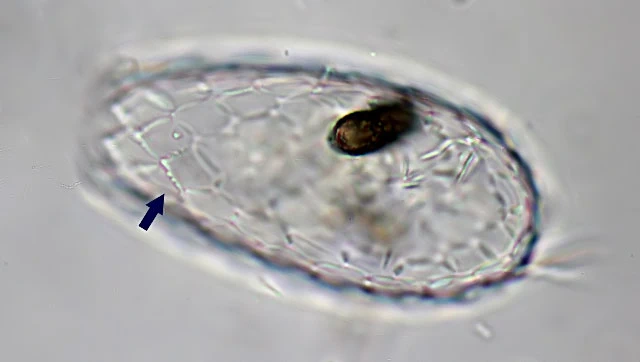

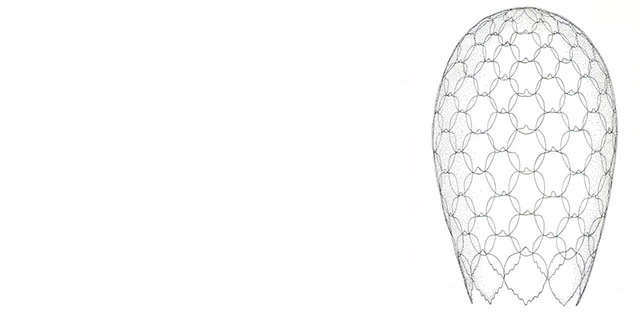
It’s probably not a separate species, but E. acanthophora without spines.
