Pelomyxa corona Frolov, Chystjakova, and Goodkov, 2004
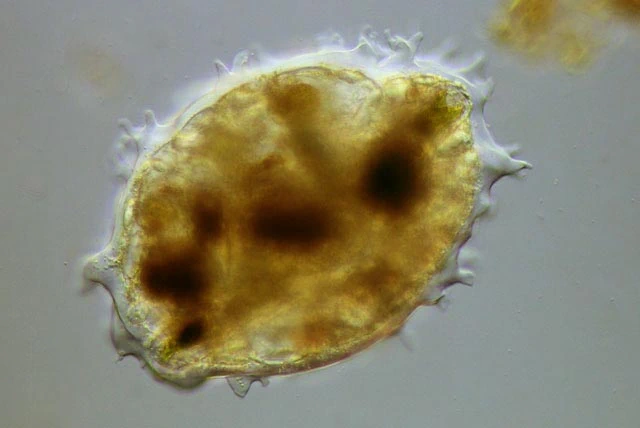
Diagnosis: Spherical Pelomyxa-like amoeba with pronounced hyaloplasm. Radiating hyaline pseudopodia of various shape slightly branched, often forked at ends. Strong hyaline lobopodium formed during locomotion. Uroid consisting of numerous hyaline cylindrical papillae. Nuclei spherical; nucleolar material is fragmented and scattered mostly at the periphery of the nucleus; nuclei numbering from 1 in young individuals to 100 and more in mature ones. cilia not found; only scarce bristle-like structures in the uroidal zone may turn out to be true, though immobile cilia.
Dimensions: Diameter of uninucleate amoebae 50-70 µm, that of multinucleate ones, 300-500 µm. The size of amoebae varies greatly. Rounded forms are 50-350 µm in diameter, rarely reaching 500 µm. Cylindrical forms reach 400 pm in length, the breadth being 50-100 µm. The length of pseudopodia usually does not exceed half of the body diameter.
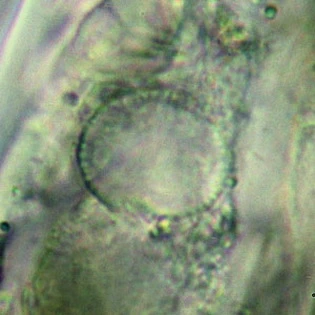
Nuclei 10-15 µm (Frolov et al, 2004); my measurements: 18-21 µm.
Ecology: In the silt of shallow ditches and ponds; small freshwater basins overgrown with water plants. Found in North-West Russia and in the Netherlands.
Remarks: The amoebae in samples usually move very little. They lie among detritus particles and are often surrounded by them. Such individuals are spherical, with their cytoplasm clearly divided into transparent homogeneous ectoplasm and very dense central endoplasm, containing food remnants, nuclei and inclusions. No food specialization has been revealed.
The cytoplasm contains a set of inclusions characteristic, in particular, of Pelomyxa palustris: diatom frustules and testate amoebae shells, spores of coniferous plants, mineral particles, etc.
The whole surface of the amoebae is covered with hyaline pseudopodia of different shape. They may branch slightly and often fork at the ends. The amoebae may engulf with their pseudopodia large food particles, mostly diatom frustules.
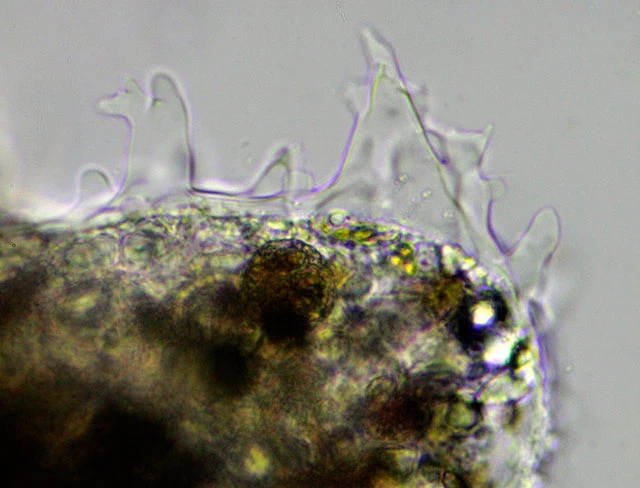
Disturbed amoebae change the body shape from spherical to cylindrical and start locomotion. During this process the anterior end forms a strong hyaline pseudopodium, whereas the hyaline pseudopodia covering the body gradually shift to the posterior end, where they retract. At the posterior end the uroid is formed or, to be precise, the uroid zone, consisting of numerous small cylindrical papillae of almost equal length. Very rarely small immobile bristle-like structures are observed among the papillae, but it is impossible to ascertain at the light microscopic level whether or not they are true cilia. The main role in locomotion is apparently played by the strong lobopodium constantly crawling over the substrate and short forked pseudopodia formed at the ventral body surface. Reaching a large moving, becomes rounded and forms radial pseudopodia.
Three types of endosymbionts, abundant in the endoplasm, are present in almost equal proportion:
- large bacteria with a pronounced cleft;
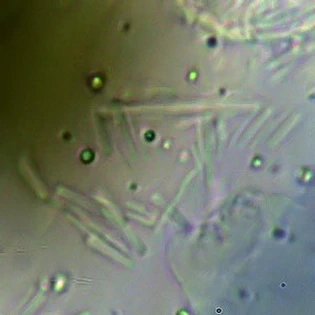
- smaller rod-like bacteria;
- large ellipsoid bacteria.
The first two types lie in symbiontophoric vacuoles whose membranes are closely opposed to the surface of the bacteria, whereas the large ellipsoid bacteria lie freely in large vacuoles, 2-3 individuals in a vacuole. In one and the same vacuole bacteria of different size and dividing bacteria are often present. While in the endoplasm bacteria of all three types form mixed accumulations, in the perinuclear space and in direct contact with the nuclear envelope only large endosymbionts with a pronounced cleft and smaller rod-like bacteria are found.