Difflugia bryophila (Penard, 1902) Jung, 1942
Basionym: Difflugia pyriformis var. bryophila Penard, 1902
Synonym: Difflugia oblonga var. bryophila (Penard, 1902) Gauthier-Lièvre & Thomas, 1958
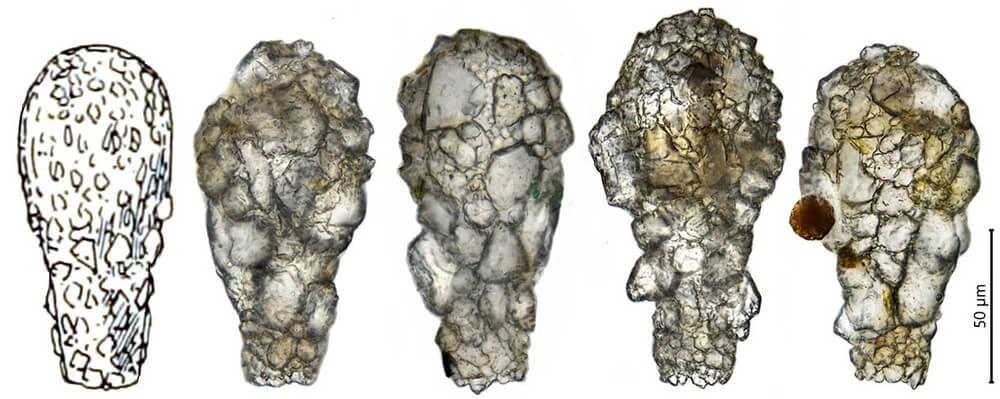
Diagnosis: Shell elongated with relatively straight sides, embedded with mineral particles. The particles are generally larger and more angular near the anterior part of the shell but become smaller and more uniform in the neck region, especially near the aperture. The shell is slightly yellowish due to the presence of a chitinous cement, which is not abundant, making the shell prone to disintegration under compression. The nucleus contains a small number of nucleoli distributed beneath the nuclear membrane, spreading out without retaining a globular form. Zoochlorellae are absent.
Dimensions: Penard (1902): Shell length 100 µm on average. Ogden (1983): 83-141 µm. Jung (1942): 94-128 µm; my measurements: 117-127 µm.
Ecology: Found in freshwater habitats and mosses, both terrestrial and aquatic. Likely cosmopolitan in distribution and commonly associated with mosses.
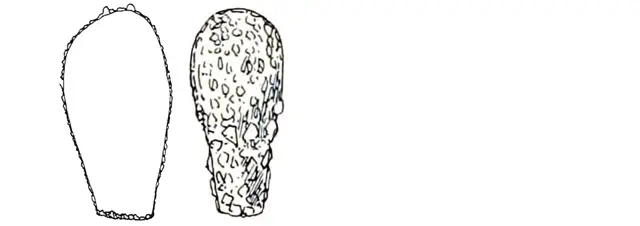
Remarks: The diagnosis is a translation of Penard’s (1902) original description. Jung (1942) reports a Length/Width (L/W) ratio of 1.9–2.4 for his specimens, while Penard’s drawings suggest a ratio closer to 2.3. A ratio below 2.3 appears improbable, as it would result in a shell that is unusually broad. Jung’s drawing depicts a shell with an L/W ratio of approximately 1.95, raising questions about whether he was observing Difflugia bryophila as described by Penard. Comparisons of both drawings are included below.
Based on Ogden (1983), the average L/W ratio is 1.82 (recalculated from his W/L ratio). Ogden noted that his “description is in good agreement with Penard (1902), who stated that the sides were rather straight.” However, Ogden’s description also refers to the shell as “pyriform,” which introduces some inconsistency in the interpretation of the shell’s shape.