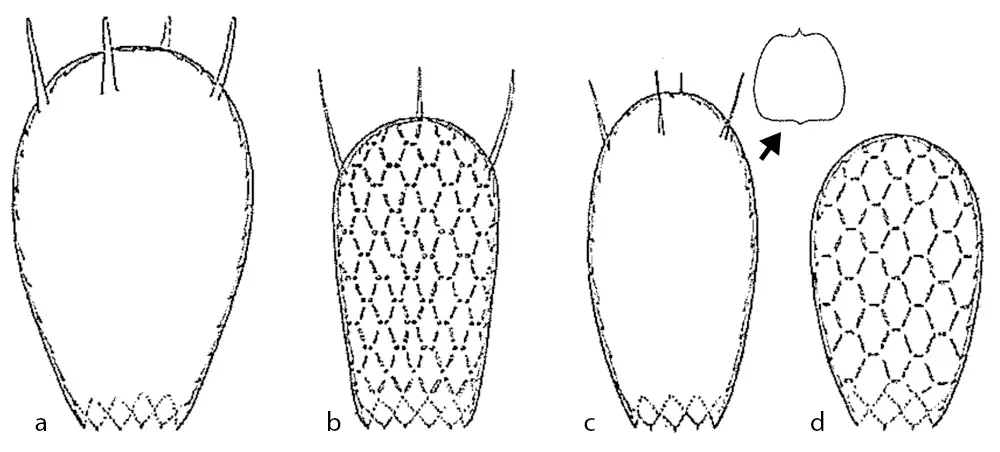
Euglypha australica Playfair, 1917
Diagnosis: Shell ovate, or broadly oval, broadest about one-third in from the fundus: dome rounded, somewhat narrowed, not semicircular; sides arching gently down to the aperture, but occasionally slightly flattened; aperture narrow, surrounded by two rows of ovate plates (5—7 visible), pointed in front, with serrated edges. Body-plates very characteristic, being recessed both front and back, with a centra), projecting spike in each recess. Tests may be found smooth or armed behind with a circle of spines, in number 1 to 5, generally 2 or 3.
Dimensions: Shell length 64—137 µm, width 32—72 µm, aperture 16—36 µm, spines up to 45 µm long.
Ecology and distribution: According to Playfair (1917): Everywhere, common.
Remarks: Playfair (1917): “This species is liable to be confounded, at first sight, with E. acanthophora, in company with which it is often found. The test is. however, more robust and siliceous, and the segregated plates are unmistakable. I t is impossible to discern the shape of the plates in the unbroken test, yet specimens may be recognized with a lens of even small definition by one point alone. With the objective a little out of focus, a dark slot, or a pair of minute, circular spots, appears at the top and bottom of each plate; the body-scales are recessed at each end, and only the two minute spikes overlap, leaving a minute foramen on either side The cement-marks also are not thin and fusiform as in E. acanthophora, but broad, rectangular slabs. The species is our most common Euglypha. It has a wide range of dimensions, but a regular series is found connecting its extreme sizes. Body-scales 10×8 µm, 11×7 µm, 11.5×10.5 µm, 12×10 µm. I have never seen this species encysted. Cf. E. crenulata Wailes, Frw. Rhiz. fr. the States, p.147, Pl. 12, f.34-37.”