
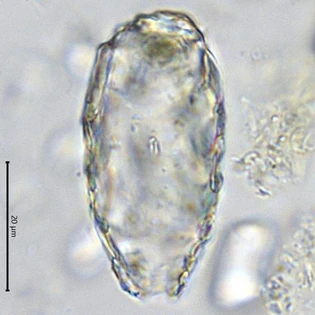
Difflugia fusiforma Siemensma, Wanner and Shimano, 2024
Diagnosis: Shell spindle-shaped, with convex sides tapering toward the aperture, being about 1/4 of the shell width. Aperture relatively small. Shell covered with relatively large flat mineral particles, giving the shell a more or less smooth contour. No living specimens have been observed.
Dimensions: Wanner et al. (2024): Shell length 38-51 µm (average 47.4 µm); width 18-23 µm (average 21.5 µm); 1.97-2.51 (average 2.21); apertural diameter 4.5-6.5 µm (average 5.3 µm).
Ecology: Freshwater.
Distribution.. Bhutan; Odenwald, Germany (Siemensma, pers. observation, 2024). Type locality: Wangdue Phodrang district, Bhutan, GPS 27.4353 N 90.1999 E.
Differential diagnosis. Difflugia fusiforma is a small but relatively long species with an L/W ratio of 1.97-2.51. Sixteen described Difflugia species and varieties and two Schoenbornia species fall partly within the size range of D. fusiforma, only six of them have more or less the same L/W ratio, but none have the same shape. D. manicata langhovdensis Sudzuki, 1964 is strongly compressed, D. stechlinensis arctica Schönborn, 1966 has parallel sides, D. partitis Godeanu, 1972 has a constriction that divides the shell into two compartments, D. pulex cuneata Plafair, 1917, is wedge-shaped and has a much larger aperture (9-15 µm), while smaller (30-42 µm), D. fallax Penard, 1890, is elongated oval or ovoid, but has a large aperture (“bouche large”), and D. subterranea Golemansky, 1970, is club-shaped, highly compressed with a large oval aperture (10-15 µm). The only species that most closely resembles the fusiform shape of D. fusiforma is D. szczepanskii Schönborn, 1965, but its shell is compressed, has a slight neck tendency, and its length is 60-80 µm.

