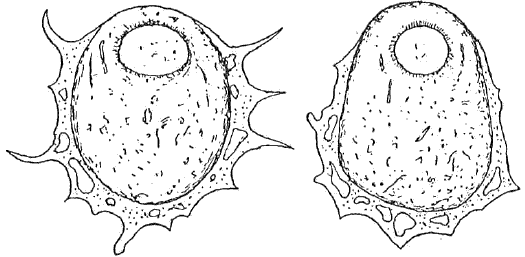
Centropyxis horrida Penard, 1911
Diagnosis: Shell flattened on its dorso-ventral axis and more strongly at its anterior part where the eccentric and inferior aperture is located; it is yellowish, formed of a relatively very clear chitin, in which are embedded thin siliceous flakes, very little distinct, then often also particles of organic nature and brownish filaments torn from mosses. But what distinguishes this form from all others of the same kind is the existence not of true horns but of a sort of wing or keel, flat, jagged, hollowed out with gaps that sometimes come to fill siliceous fragments, and which borders the entire periphery of the shell, with the exception however of the anterior part which remains smooth around the aperture. From distance to distance, then, this lamellar hull is provided with extensions sometimes rounded at their summit, sinuous, lobed, capricious in their shape, sometimes (and most often) stretched into long, sharp, straight or curved spines; more rarely finally the spines are replaced by simple angular expansions.
Dimensions: 150-170 µm.
Ecology: Mosses. Stewart Island, New-Zealand; Blue Mountains, Katoomba, Australia.