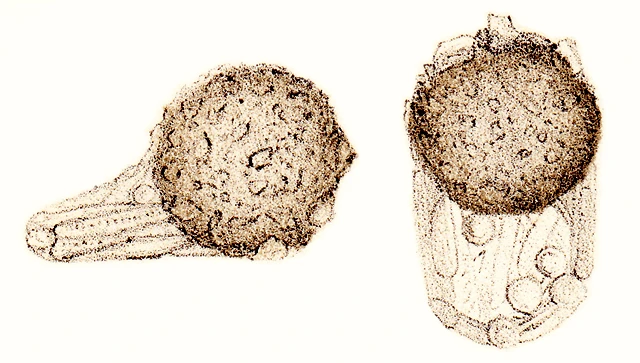
Centropyxis platystoma (Penard, 1890) Deflandre, 1929
Basionym: Difflugia platystoma Penard, 1890
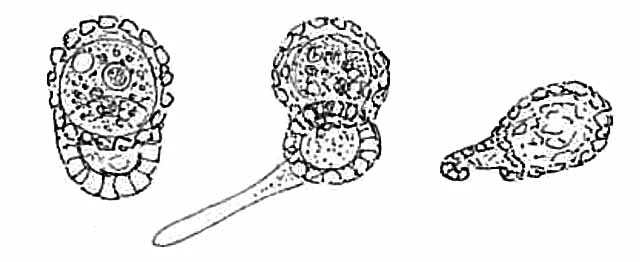
Diagnosis: Shell small, covered with mineral particles, with abundant slightly yellowish chitinous cement, ovoid-globose then spread-compressed in front above a very wide, round, eccentric mouth, lined with a ring of flat mineral particles larger than those of the rest of the shell. When the amoebae moves, the shell, flattened in front and spherical behind, drags, forming a more or less acute angle with the aperture. Seen from above, and by transparency, the individual appears double because of the oral strangulation and the strong anterior circular ring that protrudes from the main body of the shell. Often, when moving, a single broad and elongated pseudopodium is present (original description, translated from French).
Measurements: Length 30-50 µm, width 20-35 µm.
Remarks: In 1902, Penard considered this species as a variety of C. constricta. In the three drawings he published in 1890, three phenomena are clear:(1) the main body is a sphere (first picture); (2) The visor has a completely circular edge (middle picture) and (3) the edge curves inwardly (right picture). These characters belong to Conicocassis species and probably C. platystoma should be transferred to that genus.