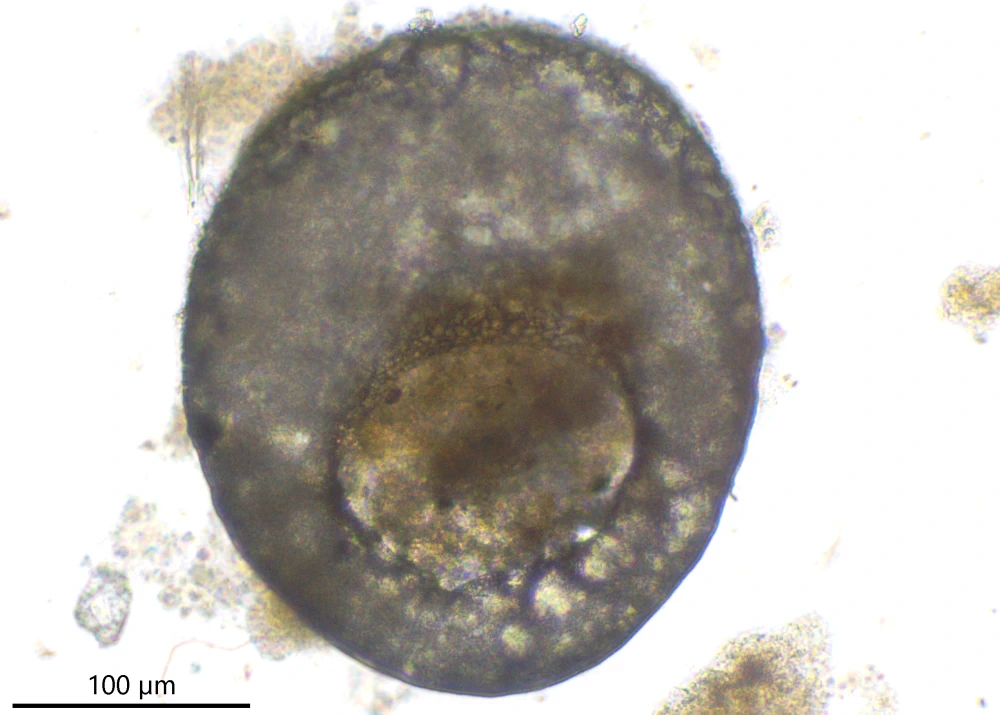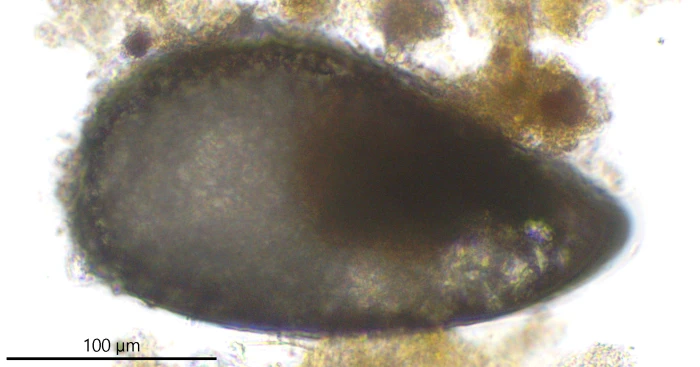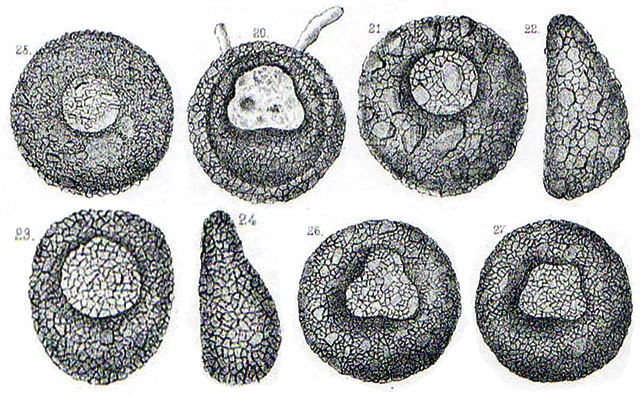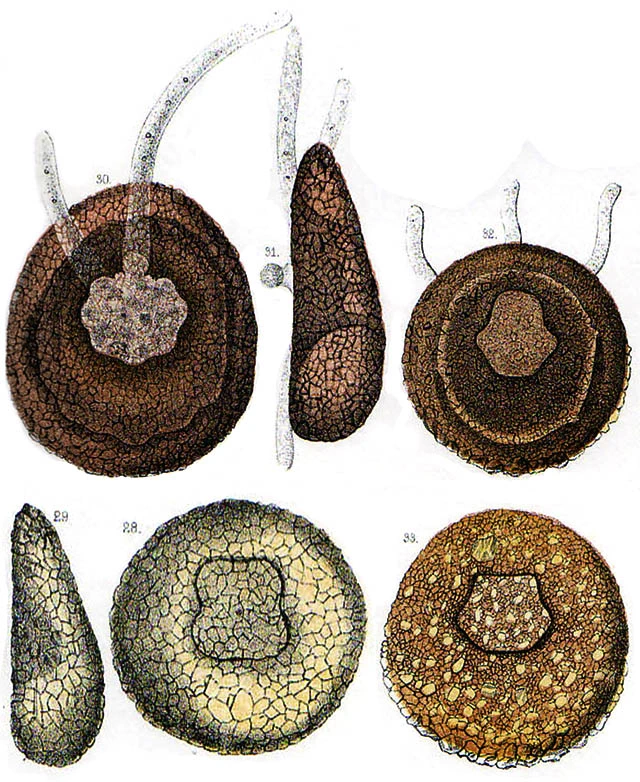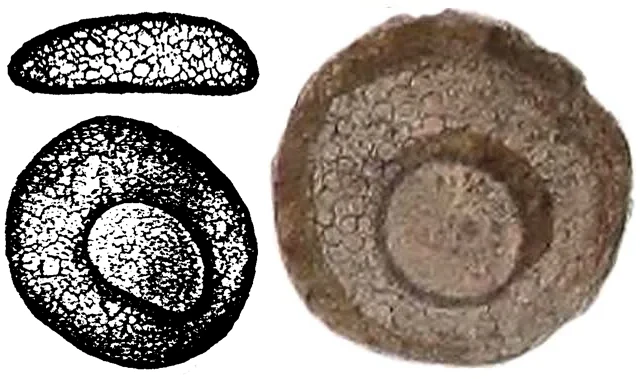
Centropyxis ecornis (Ehrenberg, 1843) Leidy, 1879
Basionym: Arcella ecornis Ehrenberg, 1843
Diagnosis: Shell of large size, usually more than 200 µm, usually circular or largely elliptical, mostly irregular in outline; in lateral view the dorsal region is spherical and tapers from the mid-body position to the apertural lip; shell rough, covered with quartz sand grains, embedded in an organic cement; color usually grey, sometimes brownish, depending upon the density of the xenosomes; aperture invaginated, oval or circular, irregularly lobed, not very much eccentric, with a thick apertural rim.
Dimensions: Literature 199-316 µm, mean 211 µm; my measurements 167-356 µm.
Ecology: Freshwater; in sediments and among water plants and mosses.
Remarks: This species is not well defined. The name means: “without spines”. Probably several species are covered by the name C. ecornis. C. cordobensis and C. lapponica might have been confused with this species.
The original description is:
“A. ecornis, magna hemisphaerica, nec tessellata, apertura extra medium magna rotunda, margine testulae integro. Habitu A. aculeatae. Icon!”
Free translation:
Arcella ecornis is large and hemispherical, without a mosaic-like pattern on the shell. The opening lies slightly beyond the midpoint, and is large and round. The edge of the shell is smooth, not serrated or damaged. In overall shape and appearance it resembles A. aculeata. See the illustration!
Ehrenberg, C.G. (1843): Verbreitung und Einfluss des mikroskopischen Lebens in Süd- und Nord-Amerika. Abhandlungen der Königlichen Akademie der Wissenschaften zu Berlin, Jahrgang 1841: 316, 368, 410.