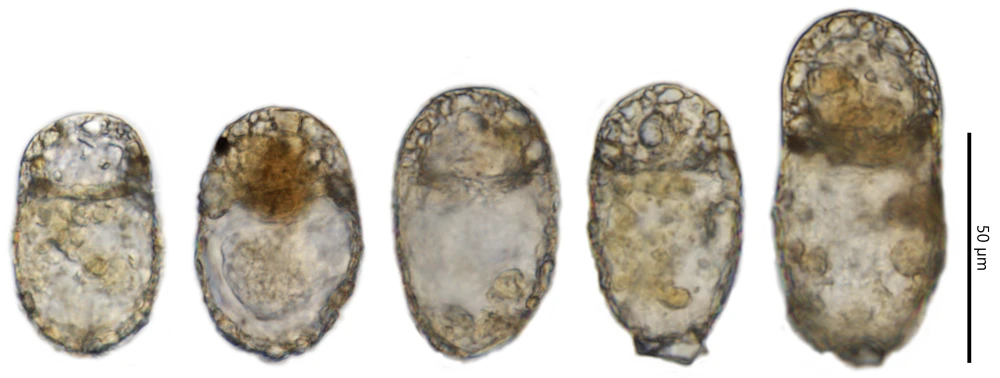
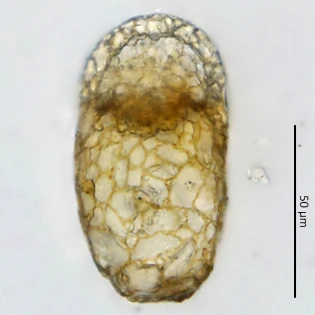
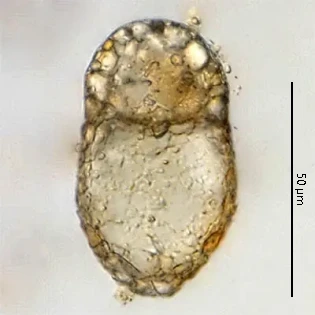
Centropyxis elongata (Penard, 1890) Thomas, 1959
Diagnosis: Shell in ventral view elliptic, elongated with almost parallel or slightly tapering lateral sides towards the aperture; test covered with irregular, transparent, thin, often flat xenosomes; posterior region in lateral view slightly inflated; aperture circular or semicircular, strongly biased towards the anterior margin, occupying a third of the entire length of the shell, commonly encrusted with mineral particles along the outer contour.
Dimensions: Length: Penard (1890) 60-75 μm, Thomas (1959) 56-65 μm, Lüftenegger et al. (1988) 47-63 μm (n=30); width of test: Penard 25-40 μm, Thomas 29-33 μm, Lüftenegger et al. 29-36 μm; width of aperture: Thomas 18-20 μm, Lüftenegger et al. 15-20 μm. My measurements: Length 45-85 μm.
Ecology: Sphagnum, soils, humus.


References:
Lueftenegger, G., Petz, W., Berger, H., Foissner, W. and Adam, H.. Morphologic and Biometric Characterization of Twenty-four Soil Testate Amoebae (Protozoa, Rhizopoda) – Arch. Protistenkd. 136 (1988): 153-189.
Thomas, R. (1959): Les Thécamoebiens muscicoles et terricoles: notions d’écologie générale et comparative. – P. Soc. Linn. Bordeaux 98: 27-53.