Centropyxis oblonga Deflandre, 1929 *)
Basionym: Centropyxis aculeata var. oblonga Deflandre, 1929
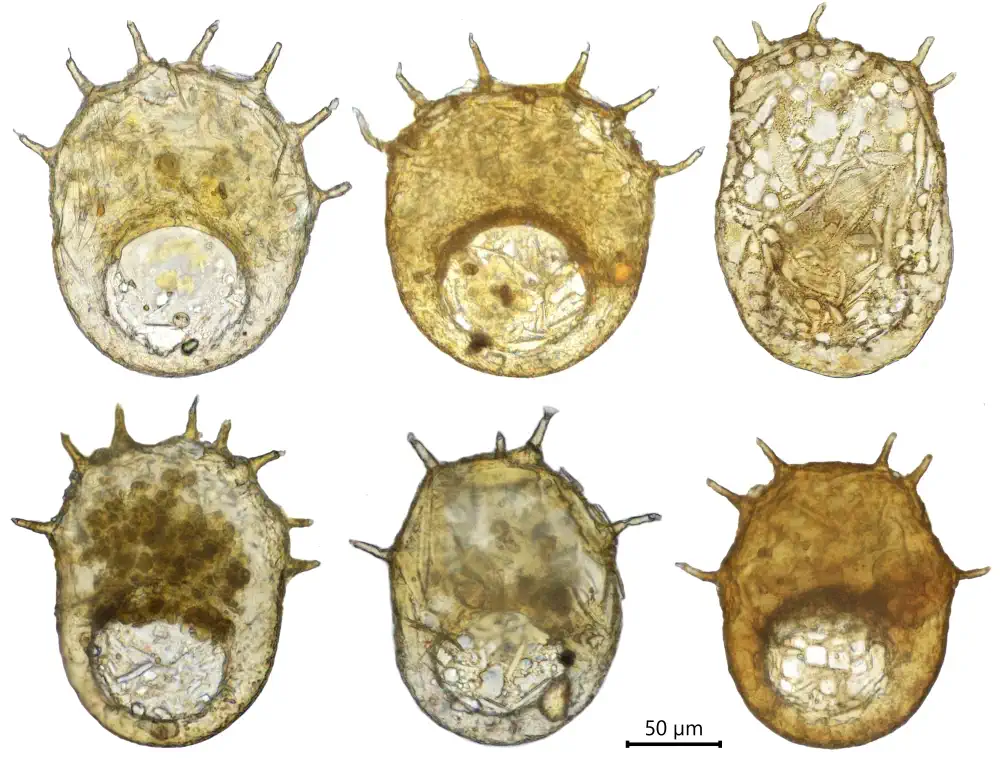
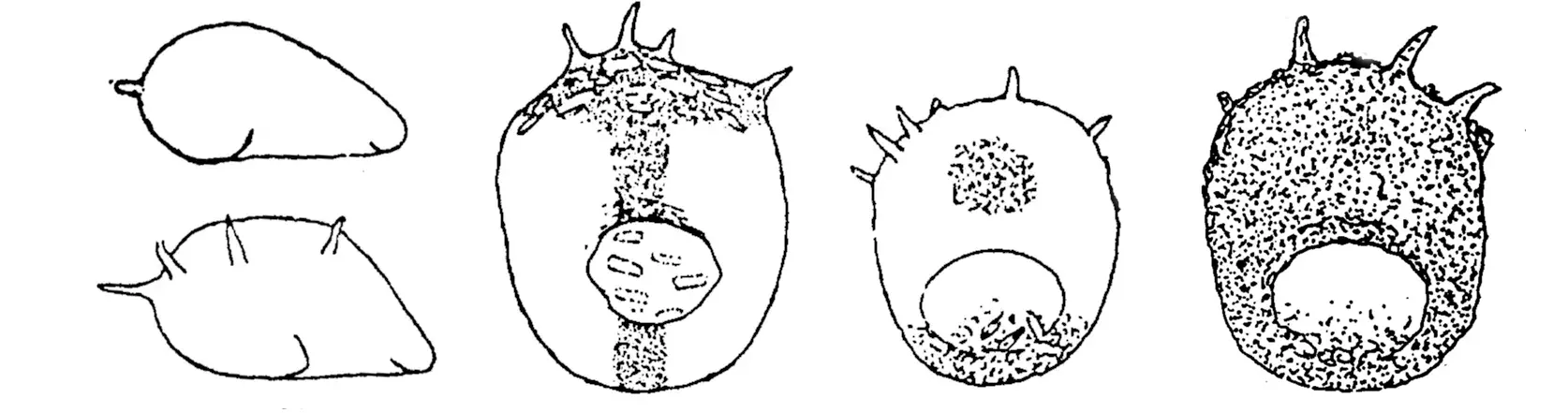
Diagnosis: In ventral view, the shell is oblong—elliptical or oval—but never circular. The aperture is proportionally larger, consistently elliptical, and often strongly eccentric. In lateral view, the shell shows a high dome, taller than that of the type specimen. The spines vary in length and number but are always positioned at the posterior end. The shell integument resembles that of the type, being punctuated to varying degrees of coarseness, with a coating of foreign material and a few stones apposed near the posterior part.
Dimensions: Deflandre (1929): Shell length without spines 106–140 µm; width 95–111 µm.
My measurements (Irish population): Shell length without spines 123–186 µm; width 96–119 µm.
Ecology: Freshwater. Probably cosmopolitan.
Remarks: In a sample from the Odenwald, a large forested region in central Germany, I found specimens that closely matched the description of C. oblonga by Deflandre (1929). However, smaller specimens with more rounded shells were also present. Morphometric analyses and morphological features showed that all these specimens belonged to a single population, though representing an unknown species. A distinctive feature shared by all shells was the presence of one or two, sometimes more, relatively large mineral particles on the anterior lip, along with a relatively small anterior lip compared with all other known species.
In 2025, I found specimens in a Sphagnum sample from Ireland that closely resembled the description of C. oblonga. Morphometric analysis showed that these specimens formed a cluster distinguishable from all other known species. As far as I know, this is the only population that may represent C. oblonga. However, the presence of one or more relatively large stones on the upper lip and the relatively small anterior lip could also indicate that it is identical to the Odenwald population. Further research is required.